
Survey Question Types: When to Use Multiple Choice, Rating Scales, and Open Text
Compare common survey question types and learn how to choose formats that produce clear, analyzable answers.

The best question type depends on the answer you need. A format that is easy to analyze is not useful if it forces respondents into an inaccurate choice. Start with the decision, then select the format.
Single choice and multiple choice are different measurements
Use single choice when the categories form one decision: current plan, primary purchase channel, or the one reason that mattered most. If several answers can be true, a forced single choice can distort the result. “Which support channels did you use?” should usually allow multiple selections; “Which channel did you use first?” should allow one. The wording must tell respondents whether they can select one or several.
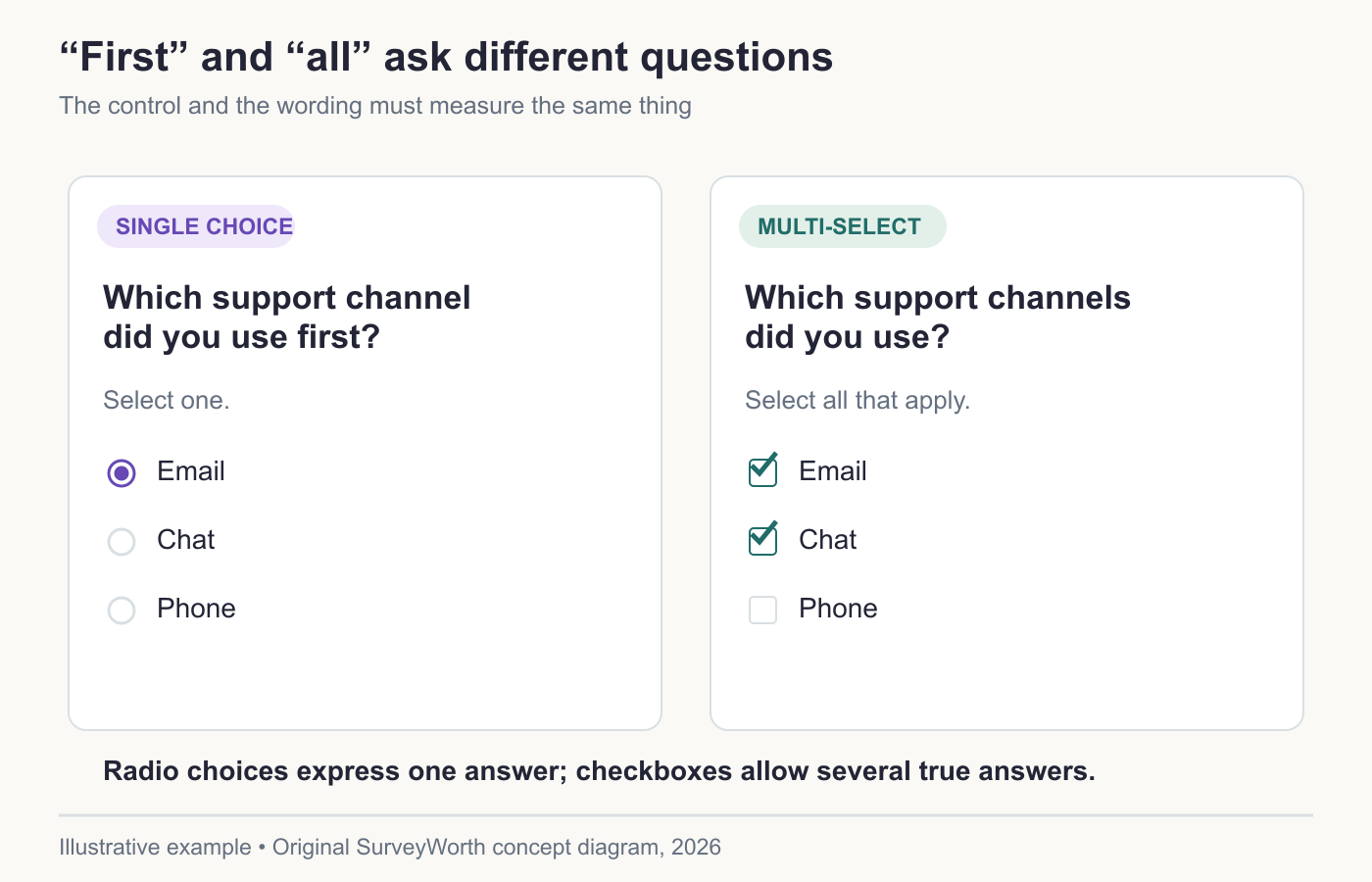
Image source: Original SurveyWorth conceptual diagram, 2026. Illustrative, not observed data or a product screenshot. Based on “Single choice and multiple choice are different measurements”.
A multiple-choice question needs careful analysis. If 40 people select email and 30 select chat out of 50 respondents, the percentages are 80% and 60%, and they correctly total more than 100%. Report the denominator and do not present the categories as if they were mutually exclusive. If a “None of these” option appears, configure it as exclusive so it cannot be selected alongside another choice.
Ratings, agreement scales, and semantic differential scales
A rating asks for degree. For satisfaction, a labeled five-point scale may be easier to interpret than an unexplained number. Agreement scales can be useful for statements such as “I understood the next step,” but writing only positively phrased statements can encourage habitual agreement. Ask about behavior directly when possible. A semantic differential can place opposite descriptors at endpoints, such as “confusing” and “clear,” but respondents must understand both words and the midpoint.
Keep the measurement stable when tracking over time. Changing from a four-point to a five-point scale, changing label wording, or reversing the direction can create a trend that reflects the instrument rather than the experience. Preserve a copy of the exact question and labels in the report.
When ranking is worth the effort
Ranking answers a relative-priority question: which of several improvements should come first? It forces tradeoffs but does not measure absolute importance. If all options are unimportant, respondents still must rank one first unless you provide a preceding relevance check. Limit ranking to a short list, especially on mobile. If you want to know whether each item is important, a separate rating or selection task may fit better.
When an open answer earns its place
Use open text when the category space is unknown, a rating needs explanation, or a person should describe a specific event. Write a prompt that points to the experience: “What information was missing when you chose a plan?” is more useful than “Any comments?” Keep it optional unless a narrative is essential to eligibility or the research design. Plan how you will code and review the answers before collecting them.
A worked choice example
A product team asks, “What should we improve?” That is too broad. It can first ask which task a user attempted, using single choice. It can then ask which problems occurred, using multiple choice with “None of these” and “Something else.” A final optional open question can ask what happened at the hardest step. This sequence produces a comparable count, a task context, and an explanation without asking the respondent to write a long essay.
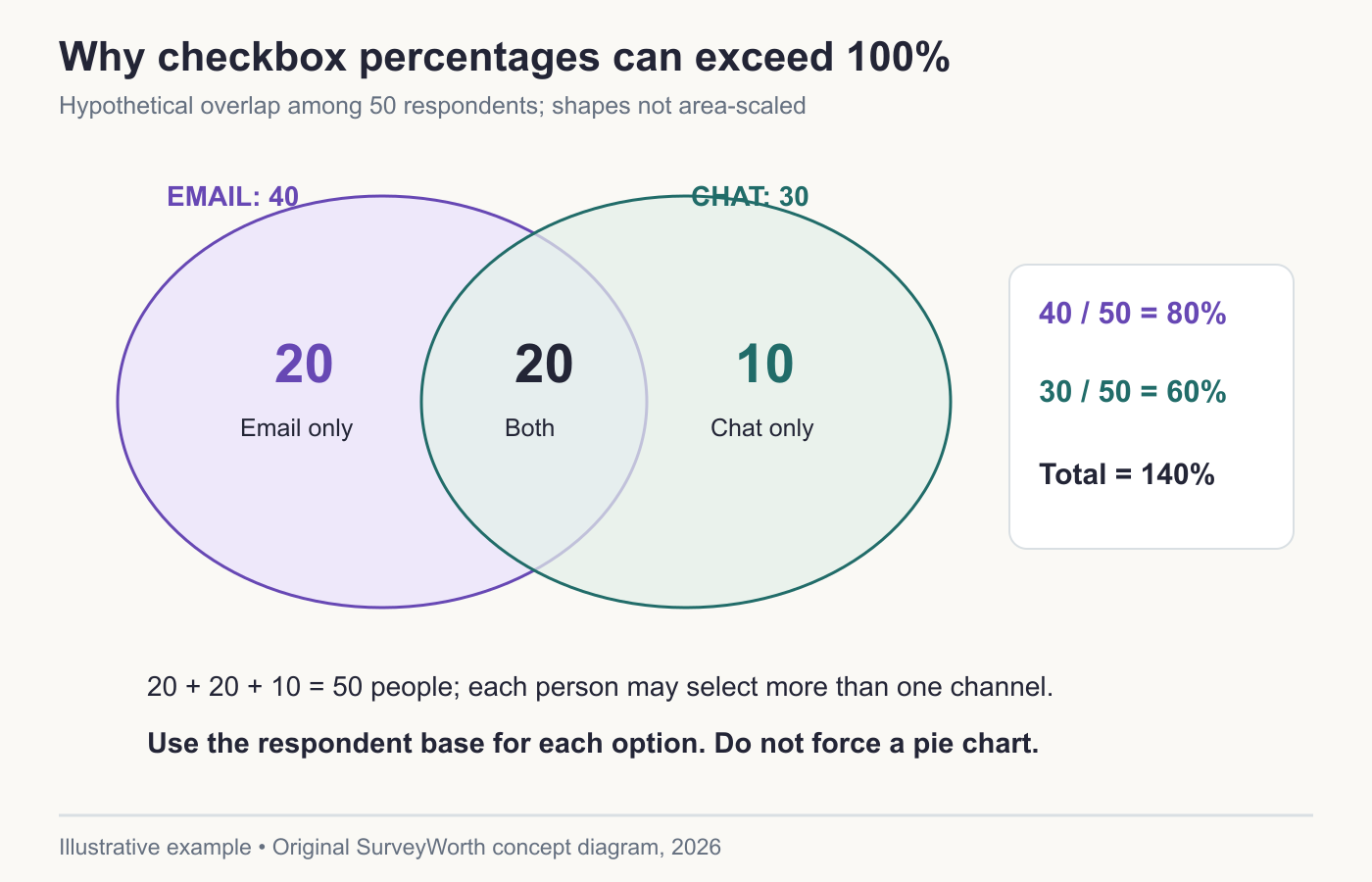
Image source: Original SurveyWorth conceptual diagram, 2026. Illustrative, not observed data or a product screenshot. Based on “Single choice and multiple choice are different measurements”.
Keep a question specification
For each item, document its exact text, whether it is required, its answer type, allowed values, “Other” handling, branch logic, and planned denominator. For a multiple-choice item, decide whether “None of these” is exclusive. For a scale, store endpoint labels and direction. For an open answer, decide whether it will be coded into themes. This specification helps analysts interpret exports months later and prevents a platform default from quietly changing the measure.
Choose the response format from the decision
Typeform’s multiple-choice guide discusses exclusive options and “Other”; its rating-scale guide separates ordered intensity from categories; its open-question discussion explains why free text can reveal unexpected reasons. The format matters because it determines the claim. A single-choice “main reason” forces priority; a checkbox “all reasons” measures mentions; an open response needs a coding plan. Do not use the same chart for all three.
| Decision | Format | Reporting rule |
|---|---|---|
| Find one primary obstacle | Single choice with nonoverlapping options. | One answer per eligible respondent. |
| Identify every encountered obstacle | Multiple choice with an exclusive “None.” | Percent selecting each option; totals can exceed 100%. |
| Explore a new problem | Optional open text. | Code themes and retain contrary cases. |
Typeform’s closed-ended-question example is useful for checking whether options cover realistic cases. Pilot ambiguous boundaries before launch. A person can encounter both delivery delay and unclear tracking; forcing one primary reason is valid only if priority is the intended measurement. Keep the exact wording and allowed values with the export. The coding guide explains the extra work created by an open item.
Prevent option design from determining the answer
An “Other” choice can conceal a missing common option. After the pilot, review what respondents wrote there; if many describe the same concrete reason, revise the list and version the item. Typeform’s ranking-question guide explains the extra cognitive work of ordering many options, while its rating-scale guide addresses labels and scale direction. Use ranking only when a priority order is the decision; otherwise a simpler choice or rating may be more reliable. If answer options are randomized, keep “None” and “Other” in sensible positions. Store the display order in the export when order effects matter; the question-order guide explains when order itself needs testing.
Test the answer options against real cases
Before fielding, invent at least three respondent stories for each consequential item. For a checkout barrier question, include a person who left because shipping cost appeared late, a person who merely paused to compare products, and a person whose payment failed. Can each person answer without selecting a misleading option? If a single-choice item mixes “too expensive” with “unexpected fees,” decide whether those are meant to be one category or different actions. If different teams own the fixes, split the choices and test whether respondents understand the distinction.
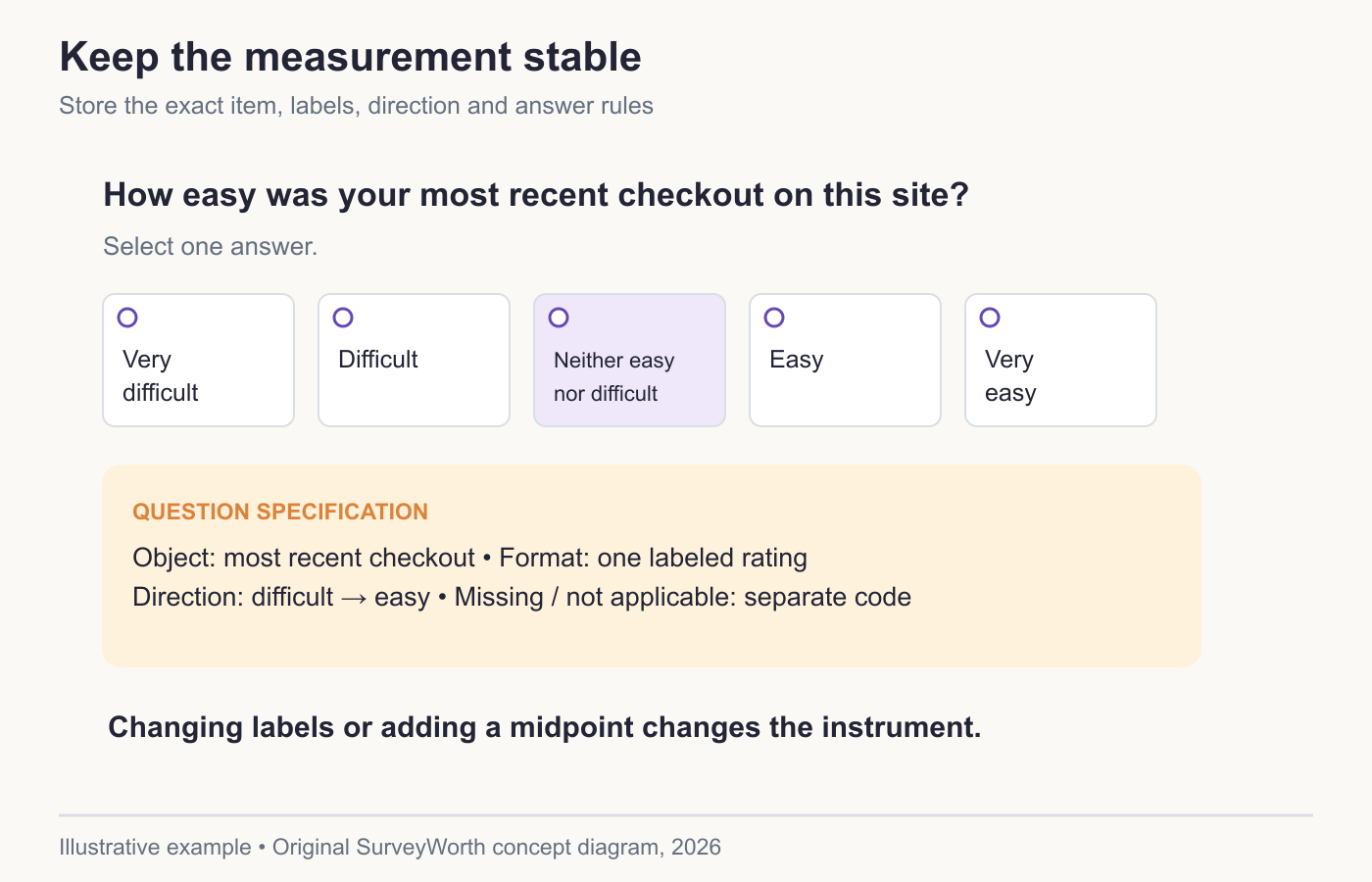
Image source: Original SurveyWorth conceptual diagram, 2026. Illustrative, not observed data or a product screenshot. Based on “Keep a question specification”.
For scales, define the object and period. “How easy was checkout?” is less precise than “How easy was it to complete your most recent checkout on this site?” Show every response label where possible. A numeric average may hide polarization; publish the distribution or at least the scoring rule with the summary. For an open item, decide in advance whether it is required, how sensitive details will be handled, and how comments will be coded. This question-level plan makes later reporting less arbitrary.
Choose tools for your next survey.
Explore survey creation software and research tools for your project.
Explore survey softwareKeep reading.

How to Test a Marketing Campaign With Surveys
Use surveys before, during, and after a campaign to test message clarity and track audience response without overclaiming causality.
Read the guide
How to Measure Brand Awareness With a Survey
Measure unaided recall and aided recognition with balanced survey questions and careful sampling.
Read the guide
How to Design a Product Testing Survey
Write product concept, prototype, and post-launch survey questions that fit what participants have actually experienced.
Read the guide