
How to Design a Product Testing Survey
Write product concept, prototype, and post-launch survey questions that fit what participants have actually experienced.

A product testing survey can support three different stages: concept, prototype, and real use. Keep the stage explicit. People can react to an idea, but they cannot accurately rate the reliability of a product they have never used.
Define the stage and evidence threshold
A concept test evaluates understanding and relevance of an idea. A prototype test evaluates an interaction that people can try. A beta or post-launch survey evaluates an experienced product. Write the stage in the brief so stakeholders do not treat concept enthusiasm as evidence of actual product performance.
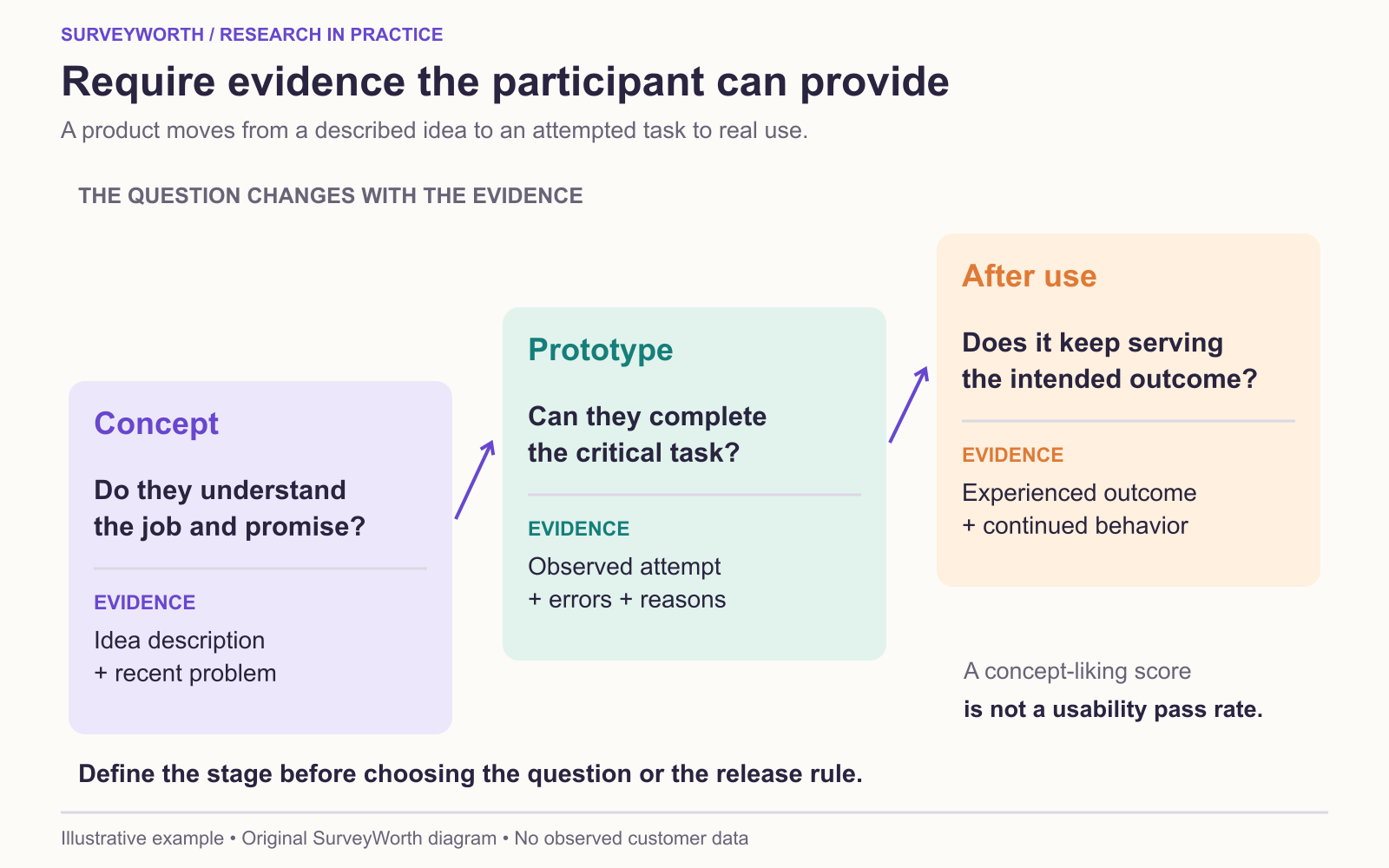
Image source: SurveyWorth original conceptual diagram, 2026. Based on “Use a different gate at each product stage” in this guide. Illustrative example; no observed survey data or official product screenshot.
At the concept stage, describe the problem and proposed solution in neutral terms. Ask what the respondent thinks the product does, which problem it addresses, and whether that problem is one they recently faced. Avoid a polished pitch that supplies all of the desired benefits and then asks for enthusiasm. A realistic price and alternative options are needed before purchase-intent answers become even directionally useful.
Pair prototype questions with tasks
For a prototype, give participants a task such as “Find a survey report for last month and share it with a teammate.” Observe success, errors, and hesitation. Then ask “What part was hardest?” and “What did you expect to happen at that point?” The observation anchors the self-report. A participant may say the interface was easy out of politeness even after failing the task; the combination reveals that mismatch.
Keep the prototype version and task text with every response. If a navigation label changes halfway through the study, results from the two versions should not be silently pooled. For a comparison, assign versions deliberately and use the same task and outcome measure where possible.
Ask real users about outcomes
After launch, recruit people who have attempted the core job. Ask what they tried to accomplish, whether they succeeded, what workaround they used, and what they would miss if the product disappeared. Analyze those answers by segment and compare them with observed use. A stated preference alone does not establish product-market fit.
A user who rarely opens a feature may still find it essential for a monthly task; a frequent click may reflect difficulty rather than value. Survey answers and behavior should be interpreted together rather than forced into agreement.
Turn feedback into a product decision
Group issues by severity, frequency among the sampled users, and the job affected. A rare task-blocking defect may outrank a common cosmetic request. Separate a proposed feature from the underlying need. “Add a dashboard” may mean “I cannot see whether my survey is complete.” Test several solutions to that need instead of implementing the first suggestion verbatim.
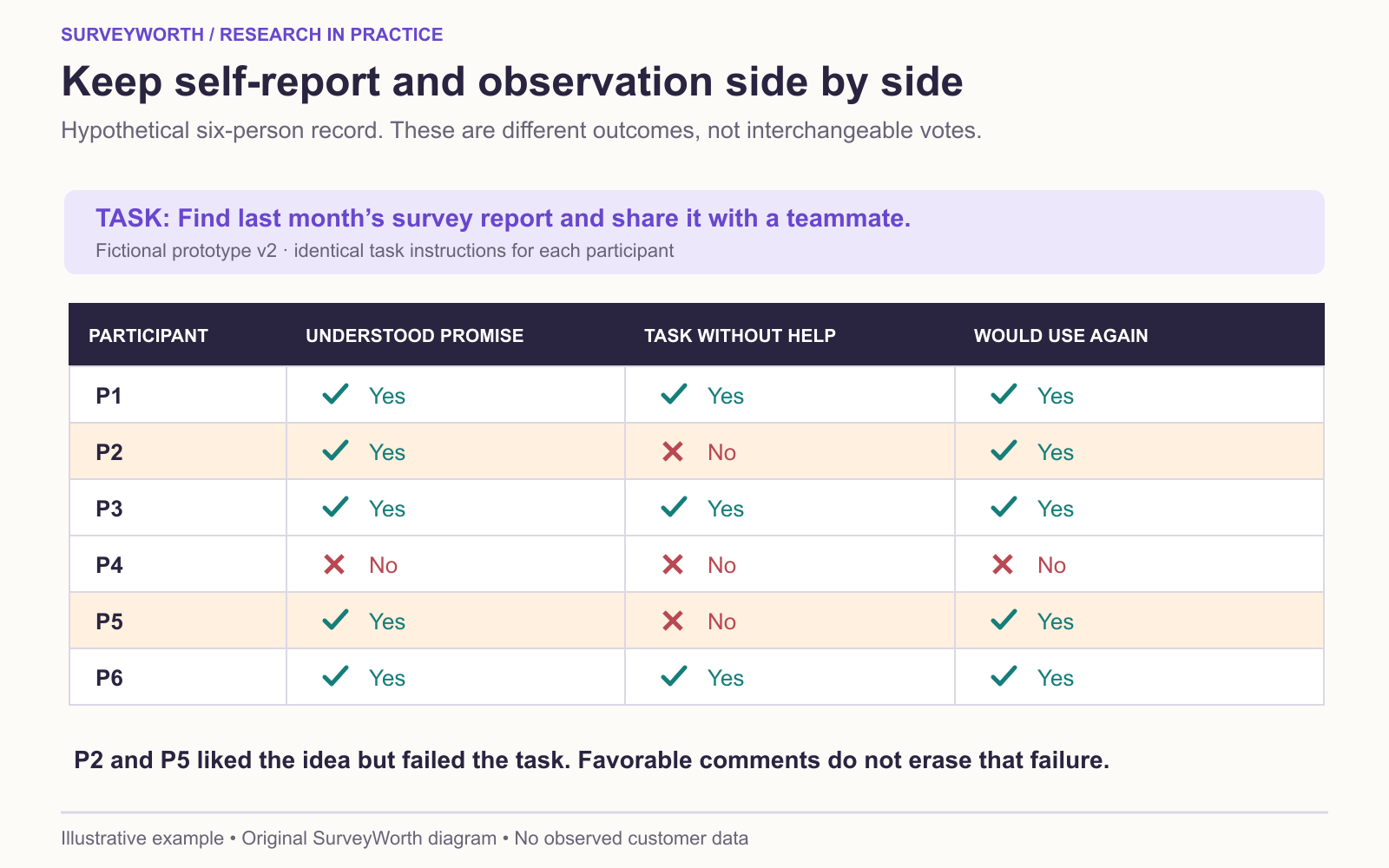
Image source: SurveyWorth original conceptual diagram, 2026. Based on “Keep three outcome columns in the decision memo” in this guide. Illustrative example; no observed survey data or official product screenshot.
End with a decision record: evidence, audience, proposed change, success measure, and next test. A product survey is strongest when it starts and ends with a specific product choice.
Set a release rule for consequential tasks
A product survey can tempt a team to average all feedback into one favorable score. For a prototype that handles billing or account deletion, that hides the most important failure. Before testing, list tasks whose failure would block a wider release, such as charging the wrong amount or deleting the wrong record. During the test, note whether each participant completed the task without help, which version they saw, and what happened when they made a mistake. An enthusiastic rating cannot cancel out a critical observed error.
For a lower-risk feature, the rule can be different: a team may accept minor confusion, revise a label, and test again with new participants. The decision memo should separate critical failures, ordinary friction, and preferences. If the same user suggests a feature, ask what job they expected it to do and observe whether another design solves the job. This is more useful than treating every request as an equal vote.
A product-test record
Save the product version, participant eligibility, task instructions, exposure time, survey wording, observed success, and main qualitative themes. Without that record, a later team cannot tell whether an improvement reflects a product change or a different test. If a prototype is incomplete, tell participants which functions are simulated, but avoid coaching them through the task being evaluated.
When asking about willingness to pay, state a realistic offering and alternative. A bare “Would you pay for this?” question invites a socially easy yes and says little about actual choice. A survey can help identify objections and price expectations, but real purchase behavior or a carefully designed experiment offers stronger evidence for a launch decision.
Use a different gate at each product stage
Typeform’s product-testing overview separates concept, prototype, comparison, beta, and postlaunch feedback; QuestionPro’s product-question bank provides many possible items. The research design should select only questions that answer the current release decision. A concept survey can measure whether people understand the job, a prototype test can observe whether they complete it, and postlaunch research can check sustained usefulness. Do not use a concept-liking percentage as a usability pass rate.
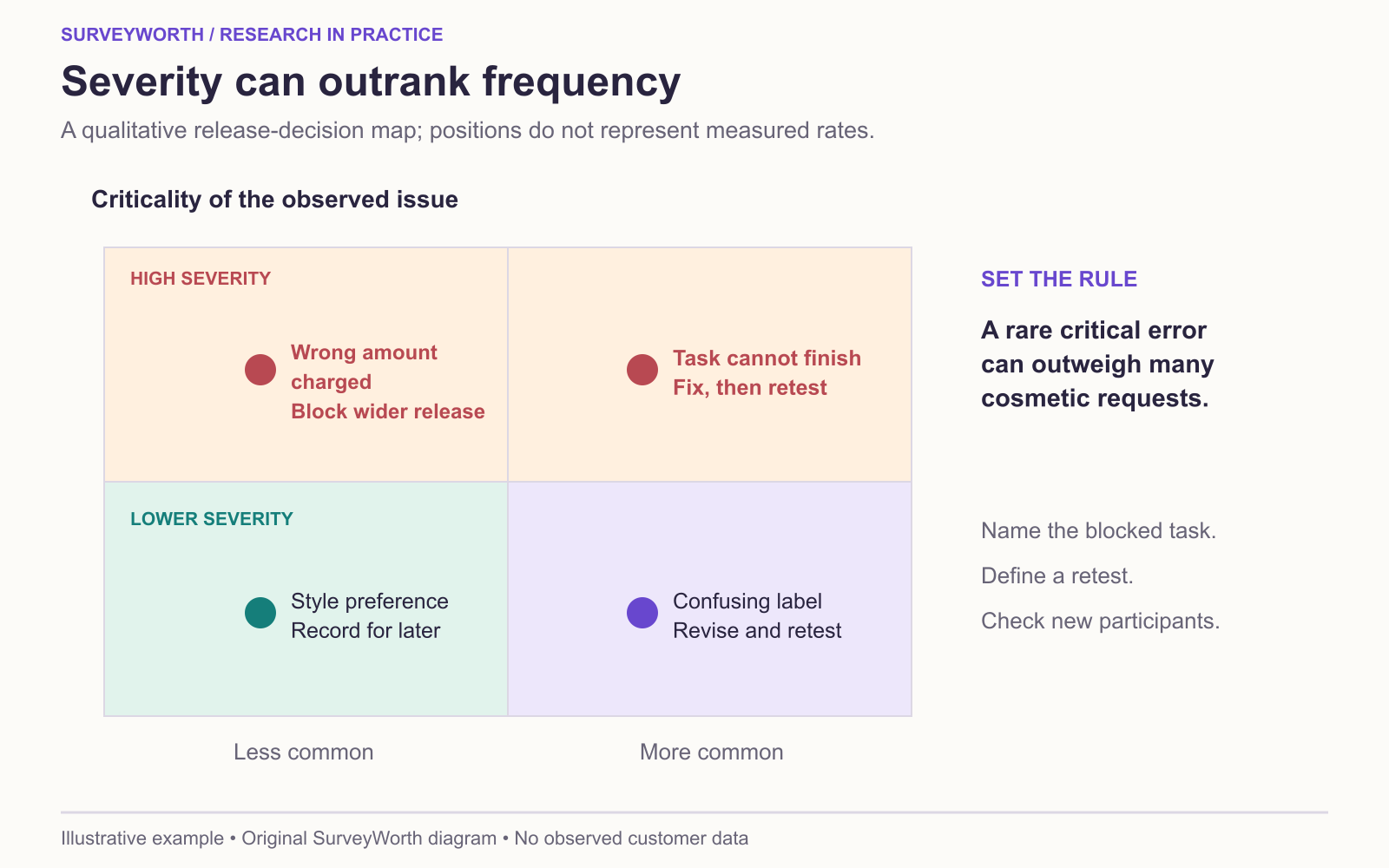
Image source: SurveyWorth original conceptual diagram, 2026. Based on “Set a release rule for consequential tasks” in this guide. Illustrative example; no observed survey data or official product screenshot.
| Stage | Minimum evidence | Decision that follows |
|---|---|---|
| Concept | Respondents explain the problem and current workaround. | Choose which idea merits a prototype. |
| Prototype | Target users complete the critical task without unsafe errors. | Repair the interaction or expand the test. |
| After use | Users report the outcome and behavior shows continued use. | Invest, reposition, or stop. |
Typeform’s product-market-fit survey discussion can prompt questions about what users would miss, but any single threshold is a heuristic tied to its sample. Show the segment, usage history, and open reasons. The unmet-needs guide helps locate a real job before concept testing.
Keep three outcome columns in the decision memo
For a prototype, record whether the participant understood the promise, whether they completed the task, and whether they say they would use it again. These columns can disagree. A participant may like the idea yet choose the wrong plan during the task. Nielsen Norman Group’s method-selection guidance explains why observed behavior adds evidence that self-report cannot supply; Typeform’s feedback-limits article cautions against treating favorable comments as proof of business effect. Set a release rule for critical failures before reviewing compliments. After launch, compare recurring usage with the reported reason for returning. The post-purchase question guide illustrates experience-stage timing. The next decision should name the evidence that would change it.
Choose tools for your next survey.
Explore survey creation software and research tools for your project.
Explore survey softwareKeep reading.

How to Test a Marketing Campaign With Surveys
Use surveys before, during, and after a campaign to test message clarity and track audience response without overclaiming causality.
Read the guide
How to Measure Brand Awareness With a Survey
Measure unaided recall and aided recognition with balanced survey questions and careful sampling.
Read the guide
How to Find Unmet Customer Needs With Market Research Surveys
Discover unmet needs by surveying real tasks, workarounds, priorities, and failed outcomes instead of asking for feature wish lists alone.
Read the guide