
How to Measure Brand Awareness With a Survey
Measure unaided recall and aided recognition with balanced survey questions and careful sampling.

Brand awareness is whether people know a brand exists and can recognize or recall it in a category. A survey can measure this, but the wording and sample determine what the results mean.
Decide which awareness measure matters
Unaided recall asks people to produce a brand name without seeing it. Aided recognition asks whether they know a brand after seeing its name or logo. Familiarity asks how much they believe they know. These are related but distinct. A respondent may recognize a brand from a list while never recalling it spontaneously; that is not an inconsistency.
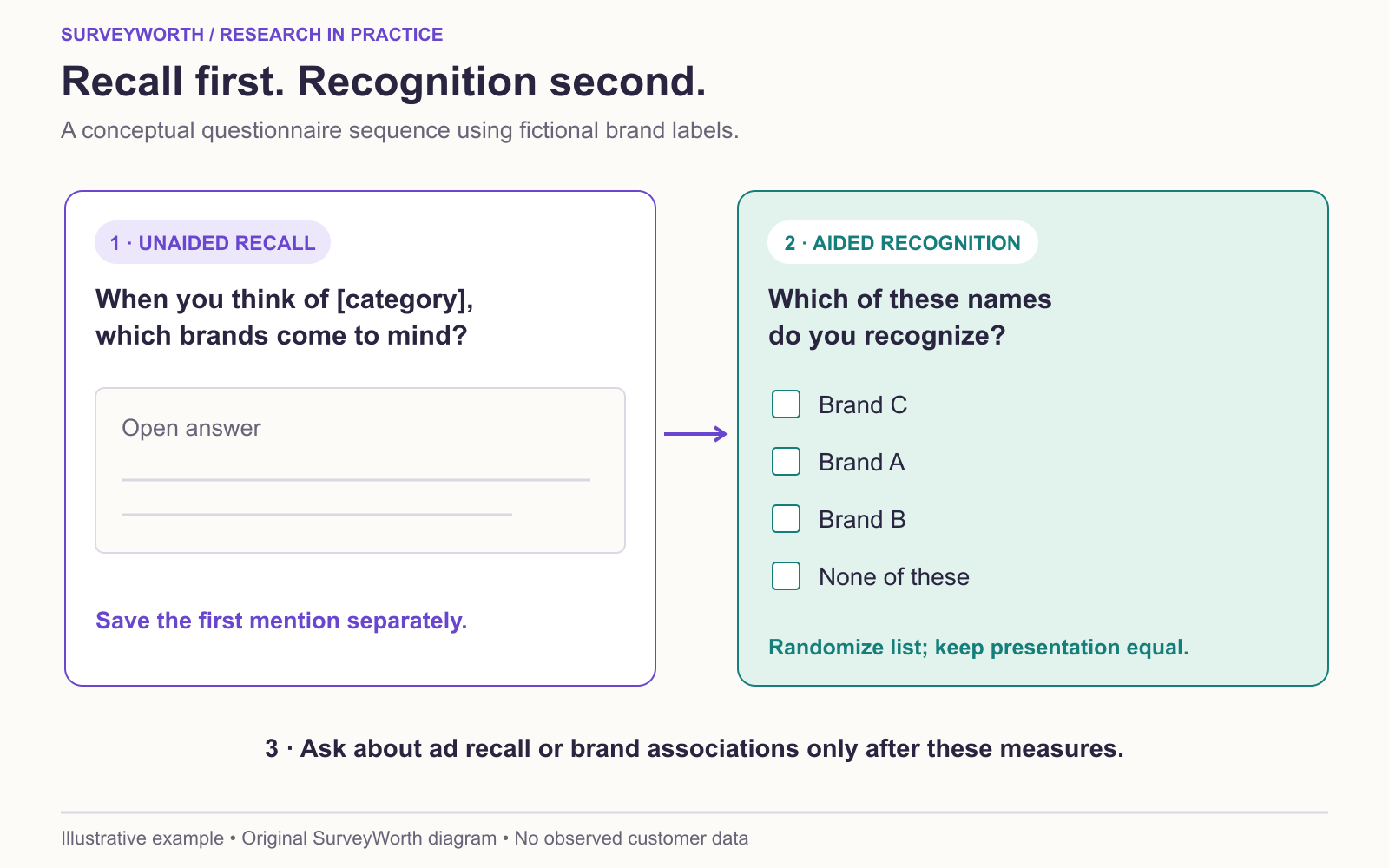
Image source: SurveyWorth original conceptual diagram, 2026. Based on “Run the recall-to-recognition sequence without priming” in this guide. Illustrative example; no observed survey data or official product screenshot.
Define the category carefully. “Online survey tools” may include products for researchers, teachers, and consumers. If the business decision concerns U.S. small-business buyers, recruit that audience rather than all U.S. adults. The category wording should be broad enough to invite genuine recall without naming the brand or leading to one answer.
Design the sample for the claim
Surveying current customers will almost certainly overstate awareness in the market you hope to reach. A brand newsletter list has the same problem. If you want a market estimate, use the sampling-methods guide to select from a frame that covers the intended category buyers. Document selection, nonresponse, and weighting. AAPOR best practices call for disclosure of the target population, selection, mode, questions, and weighting behind a reported survey result. If you use a convenience sample, frame the result as exploratory feedback from that audience.
For a tracking program, hold the population definition, question wording, competitor list rules, and measurement order stable. Adding a highly recognizable brand to the aided list or switching from text names to logos can alter the result. Report unweighted and weighted bases if weighting is used and explain the method.
Keep category entry fair
If the first question describes your brand’s unique selling point, it can prime recall even without naming the brand. Use a category definition that a neutral researcher would recognize. In the aided list, avoid making the focal brand visually distinctive through capitalization, logo size, or placement. A fair instrument gives every listed brand a comparable presentation and preserves the unaided item before any list appears.
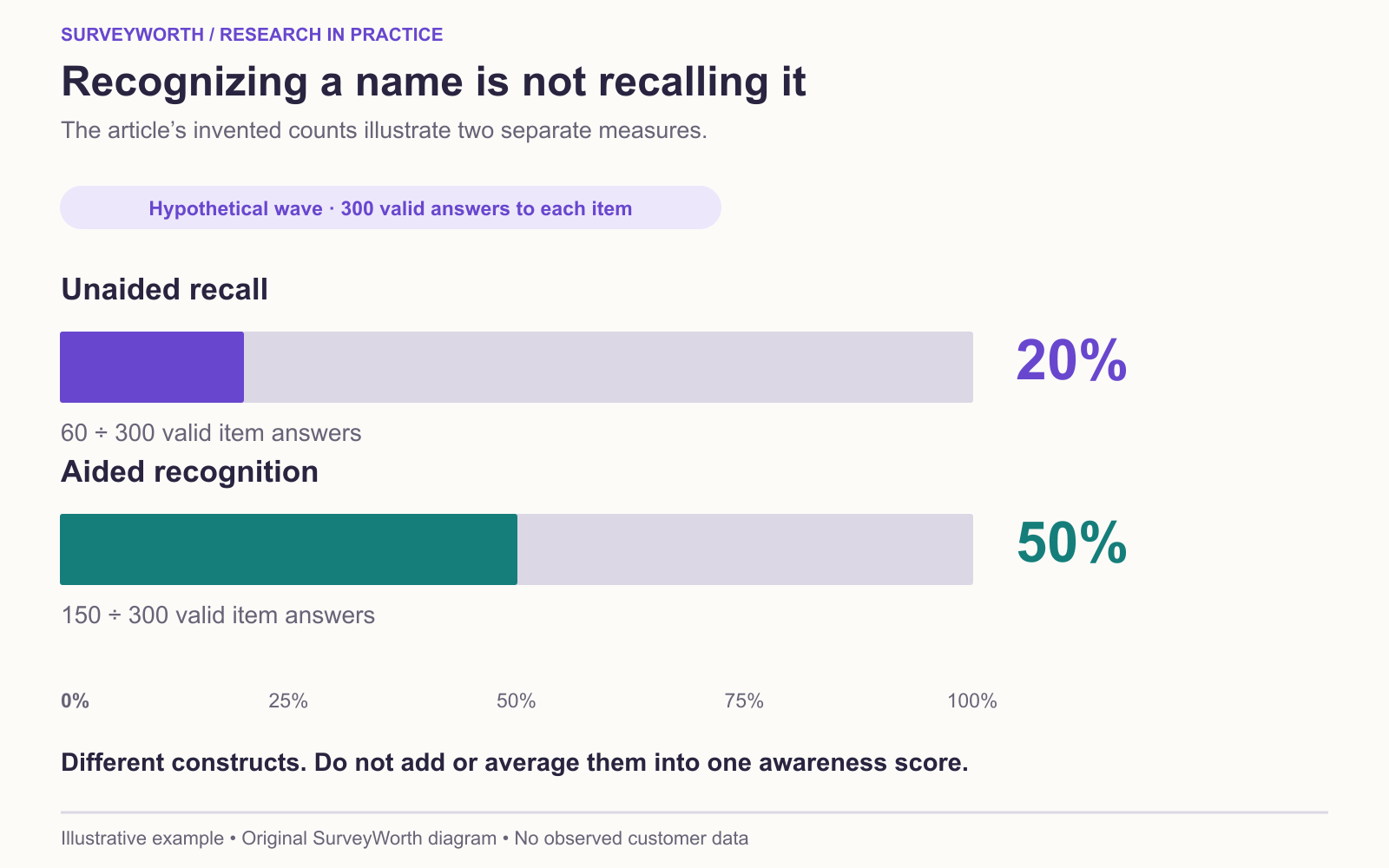
Image source: SurveyWorth original conceptual diagram, 2026. Based on “Run the recall-to-recognition sequence without priming” in this guide. Illustrative example; no observed survey data or official product screenshot.
If a study tracks several brands, apply the same coding and recognition rules to every one. Do not resolve an ambiguous answer generously for the focal brand and strictly for competitors. Keep a versioned codebook and review uncertain mentions without knowing the desired campaign outcome where practical. Consistent treatment is essential when a small change in recall is used to judge a major marketing investment.
Run the recall-to-recognition sequence without priming
Use one questionnaire order for every wave. First ask, “When you think of [category], which brands come to mind?” without a list. Save the first brand named separately from all brands named. Next show a randomized list of brands, including plausible alternatives, and ask which ones respondents recognize. Only after those measures should you ask about ad recall or brand associations. Typeform’s brand-awareness overview separates recognition from broader attitudes, and QuestionPro’s brand-awareness guide distinguishes first mention, unaided recall, and aided recognition. Those measures capture different aspects of awareness and may have different valid-answer bases. Report each separately instead of merging them into a single “awareness” percentage.
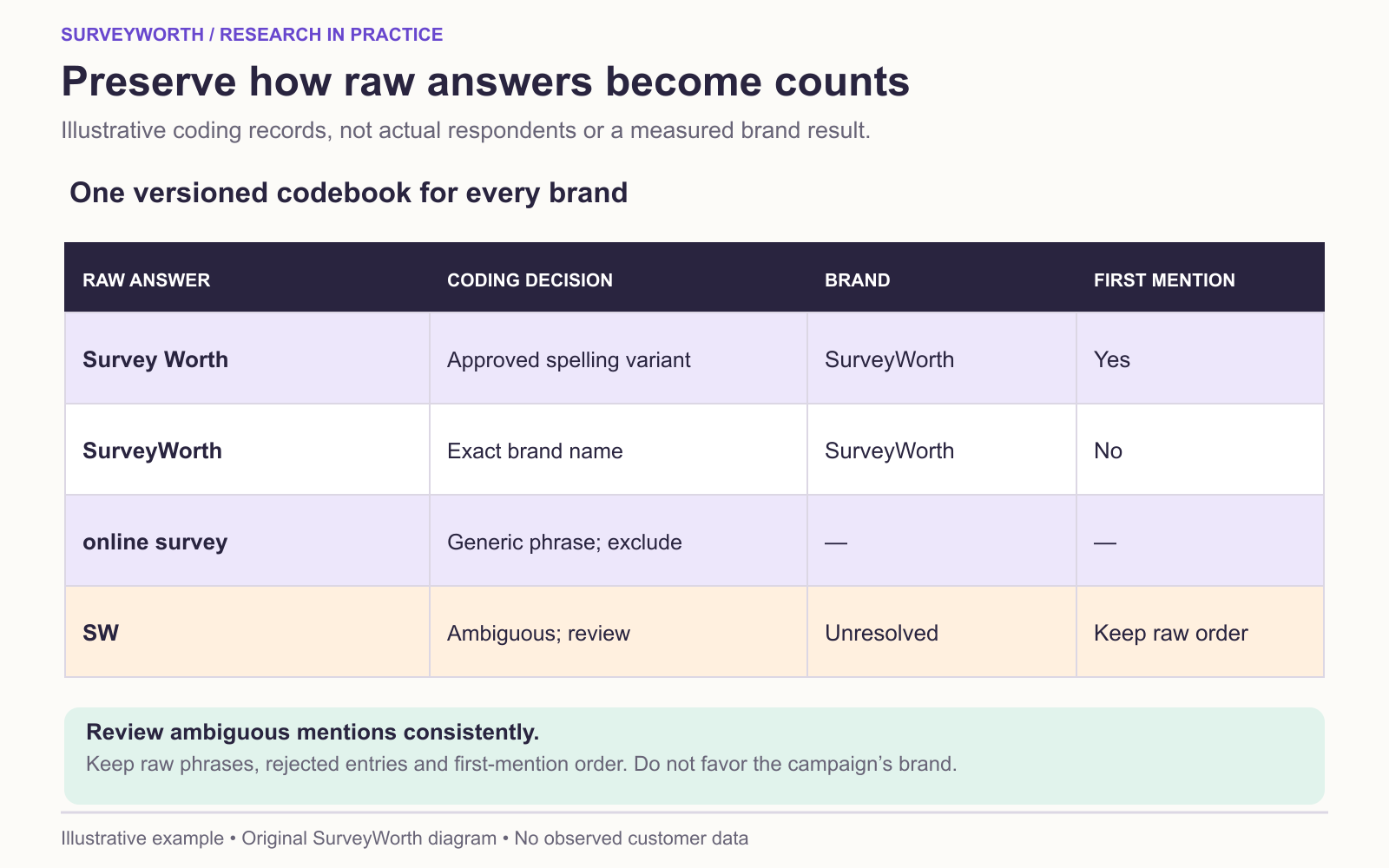
Image source: SurveyWorth original conceptual diagram, 2026. Based on “Preserve a coding sheet for every wave” in this guide. Illustrative example; no observed survey data or official product screenshot.
For a hypothetical wave with 300 eligible respondents, suppose 60 name SurveyWorth unaided and 150 recognize it when prompted. Report 60/300 and 150/300 as separate measures. If a person skips the prompted item, show the valid item base rather than automatically carrying 300 forward. Keep population, recruitment, list composition, and order stable between waves. AAPOR’s disclosure guidance explains why sample selection and exact wording belong beside the chart. If the study later estimates campaign lift, use the separate campaign-testing guide to define a comparison group.
Preserve a coding sheet for every wave
Unaided recall needs a written rule for variants before the analyst sees the campaign result. Record the raw phrase, whether it is a valid category brand, which brand it maps to, and whether it was named first. “Survey Worth,” “SurveyWorth,” and a plausible abbreviation may refer to the same brand; a generic phrase such as “online survey” may not. Have a second coder review ambiguous entries without knowing which brand the campaign favors. Keep rejected and uncertain mentions visible in the audit sheet rather than silently moving them into the focal brand’s total. This is especially important when a small change in first mention could trigger a large media decision.
For aided recognition, record the exact list shown, whether text or logos were used, and the display order. If a respondent selects “None of these,” ensure it is exclusive. A response such as “I recognize the name but have never used it” is recognition, not customer experience or preference. The final chart should show first mention, any unaided mention, and aided recognition as separate rows with valid item bases. That makes the next wave reproducible and keeps a change in questionnaire design from masquerading as a market shift.
Interpret a wave without attributing it to advertising
Suppose unaided recall rises from 20% to 24% in two waves. Before calling that campaign lift, check whether the same kinds of U.S. category buyers were sampled, whether the category prompt and brand coding stayed identical, and whether competitors changed activity. Typeform’s brand-awareness design discussion emphasizes consistent measurement; QuestionPro’s brand-attribute guide shows that knowing a brand and associating qualities with it are distinct outcomes. Report the raw respondent counts and uncertainty, then test attribution with a stronger design if the business decision depends on campaign effects. A wave-to-wave chart describes change; it does not isolate the cause.
Choose tools for your next survey.
Explore survey creation software and research tools for your project.
Explore survey softwareKeep reading.

How to Test a Marketing Campaign With Surveys
Use surveys before, during, and after a campaign to test message clarity and track audience response without overclaiming causality.
Read the guide
How to Design a Product Testing Survey
Write product concept, prototype, and post-launch survey questions that fit what participants have actually experienced.
Read the guide
How to Find Unmet Customer Needs With Market Research Surveys
Discover unmet needs by surveying real tasks, workarounds, priorities, and failed outcomes instead of asking for feature wish lists alone.
Read the guide