
How to Write Clear, Neutral Survey Questions
Learn to remove leading language, double questions, vague time frames, and overlapping answer choices from surveys.
A neutral survey question lets respondents report their experience without being pushed toward a preferred answer. The simplest test is to ask whether someone who disagrees with your assumption can still answer honestly.
Identify the hidden assumption
Read each draft and underline facts it assumes. “Why was our new plan confusing?” assumes the respondent saw the plan and found it confusing. Ask those things separately. Begin with “Have you seen the new plan?” and, for eligible respondents, “How clear was the plan description?” Only then ask what was unclear. This prevents a form from manufacturing a problem or forcing an ineligible answer.
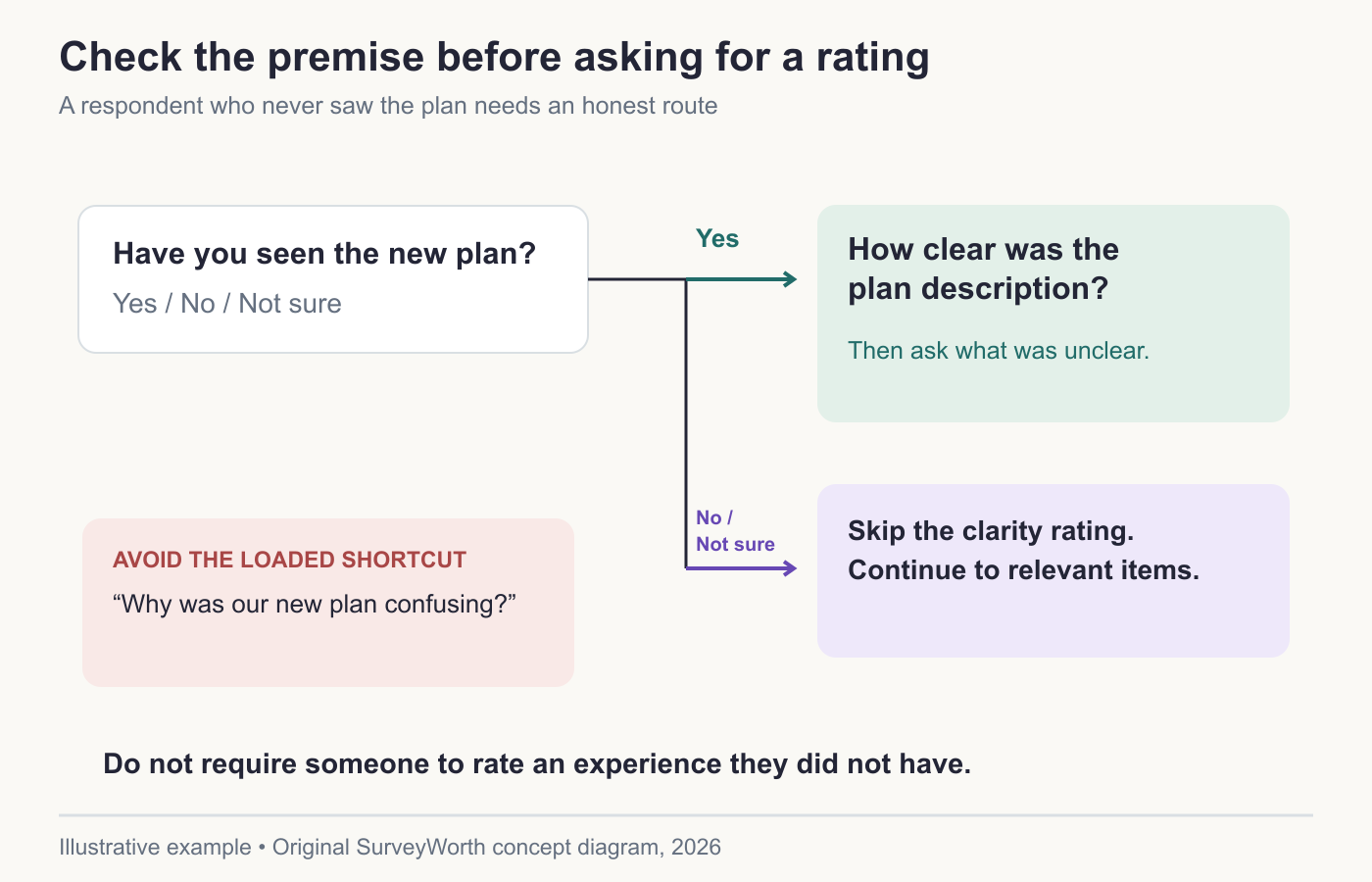
Image source: Original SurveyWorth conceptual diagram, 2026. Illustrative, not observed data or a product screenshot. Based on “Identify the hidden assumption”.
Double-barreled questions are another hidden assumption. “Was delivery fast and reliable?” cannot distinguish a fast but damaged shipment from a slow but intact one. Split speed, condition, and reliability only if each measure informs a possible action. If the survey has no way to act on all three, choose the most relevant construct rather than asking everything.
Use a precise reference period
Words such as “usually,” “often,” and “recently” mean different things to different people. “In the past 30 days, how many times did you contact support?” defines a recall window. For rare events, a longer window may be needed, but memories become less reliable. If you ask about the last interaction, make sure respondents can identify it. Avoid asking someone to reconstruct an exact date if an approximate category is enough.
A useful item also names the object being rated. “How satisfied are you?” could refer to the order, product, delivery, or company. “How satisfied were you with the outcome of your most recent support request?” is more specific. It should appear only for someone who actually made a support request, including people whose issue remains unresolved.
Balance answer choices and labels
A symmetric scale gives respondents room for positive and negative evaluations. Do not use “Excellent, Very good, Good, Fair, Poor” and assume it is balanced; it has more positive labels than negative ones. If a neutral position is meaningful, include it deliberately. If “Not applicable” or “I do not remember” is possible, provide it rather than forcing an arbitrary score.
For numeric ranges, check boundaries. “0–10, 10–20, 20+” overlaps at 10 and 20. For reasons, avoid mixing dimensions: “too expensive” is a price judgment, while “not enough value” concerns the relationship between benefits and cost. Both may be worth separate choices after pilot testing.
Test wording with cognitive probes
Show the draft to people outside the writing team. Ask, “What does this phrase mean to you?” and “How did you decide on that answer?” Listen for two different interpretations of the same term. If respondents consistently ask for clarification, rewrite. Do not explain the intended meaning during the test; that hides the problem.
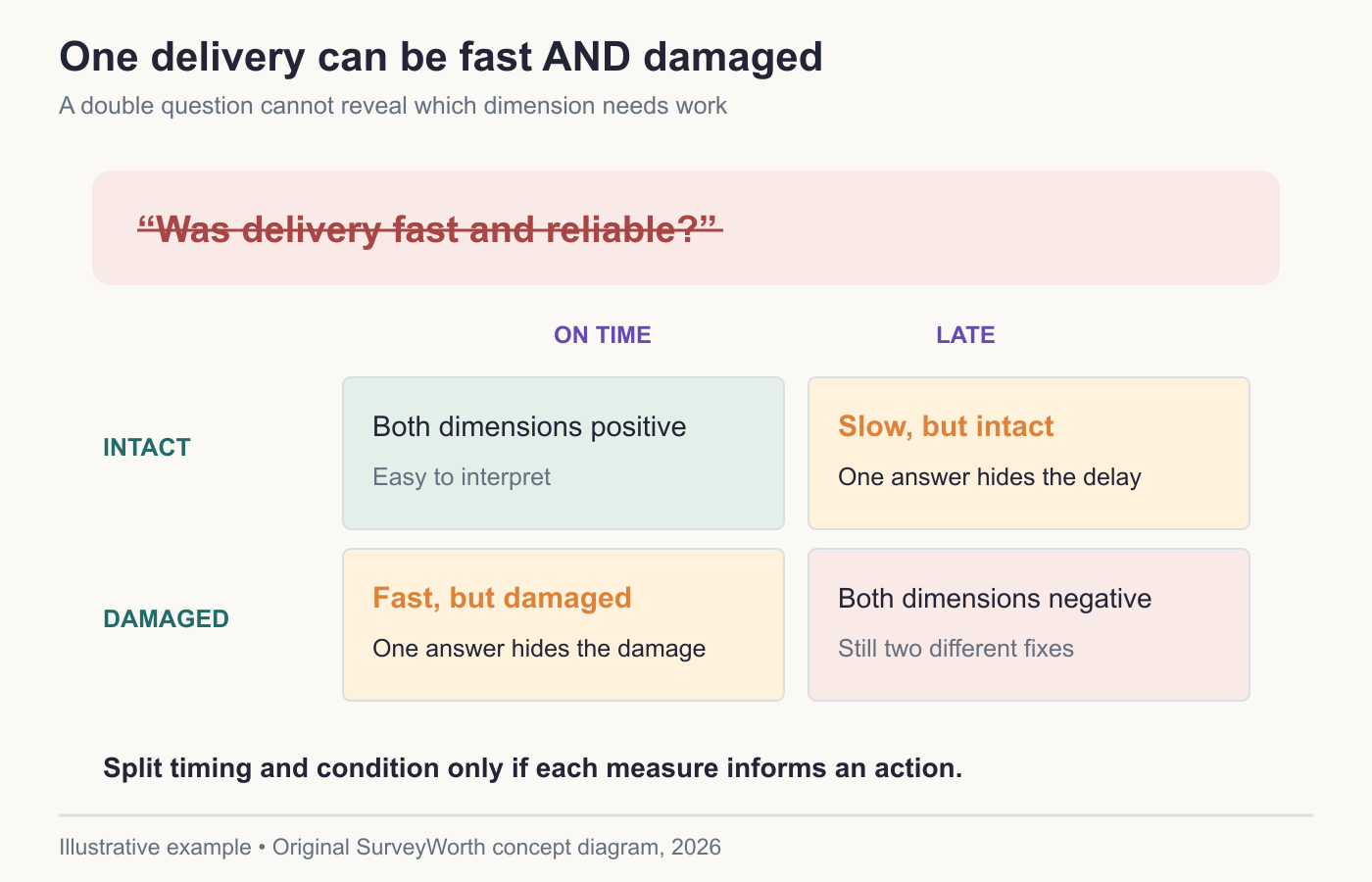
Image source: Original SurveyWorth conceptual diagram, 2026. Illustrative, not observed data or a product screenshot. Based on “Identify the hidden assumption”.
Neutrality does not require blandness. It requires a question that allows an honest answer from people with different experiences. Your final report should include exact wording for consequential measures so a reader can judge the result.
A five-question editing pass
For each draft item, ask: (1) Does it presume an experience the respondent may not have had? (2) Does it ask more than one thing? (3) Is the reference period clear? (4) Could a reasonable person find no truthful answer option? (5) Would someone with the opposite opinion still understand it as fair? If any answer exposes a problem, rewrite and test the item. Keep the original and revised versions in your research notes so the reason for the change is visible.
Preserve what changed in a rewrite
A wording change can alter the measure. “How easy was checkout?” and “How easy was checkout compared with other stores?” do not ask the same thing. If a tracked question is revised, annotate the date and avoid drawing a simple before-and-after conclusion. In reports, quote the exact item for headline results. Readers should not have to guess whether the chart title paraphrases a stronger or weaker question.
Edit the response path as well as the sentence
Involve.me’s question-writing dos and don’ts identifies leading and double-barreled wording. Typeform’s bias review also examines answer choices and order. Apply those ideas to a complete route: ask whether a visitor intended to buy today before asking for a “reason for abandoning purchase”; otherwise the follow-up falsely assumes an intention. A neutral sentence can still be biased when everyone is forced down the same branch.
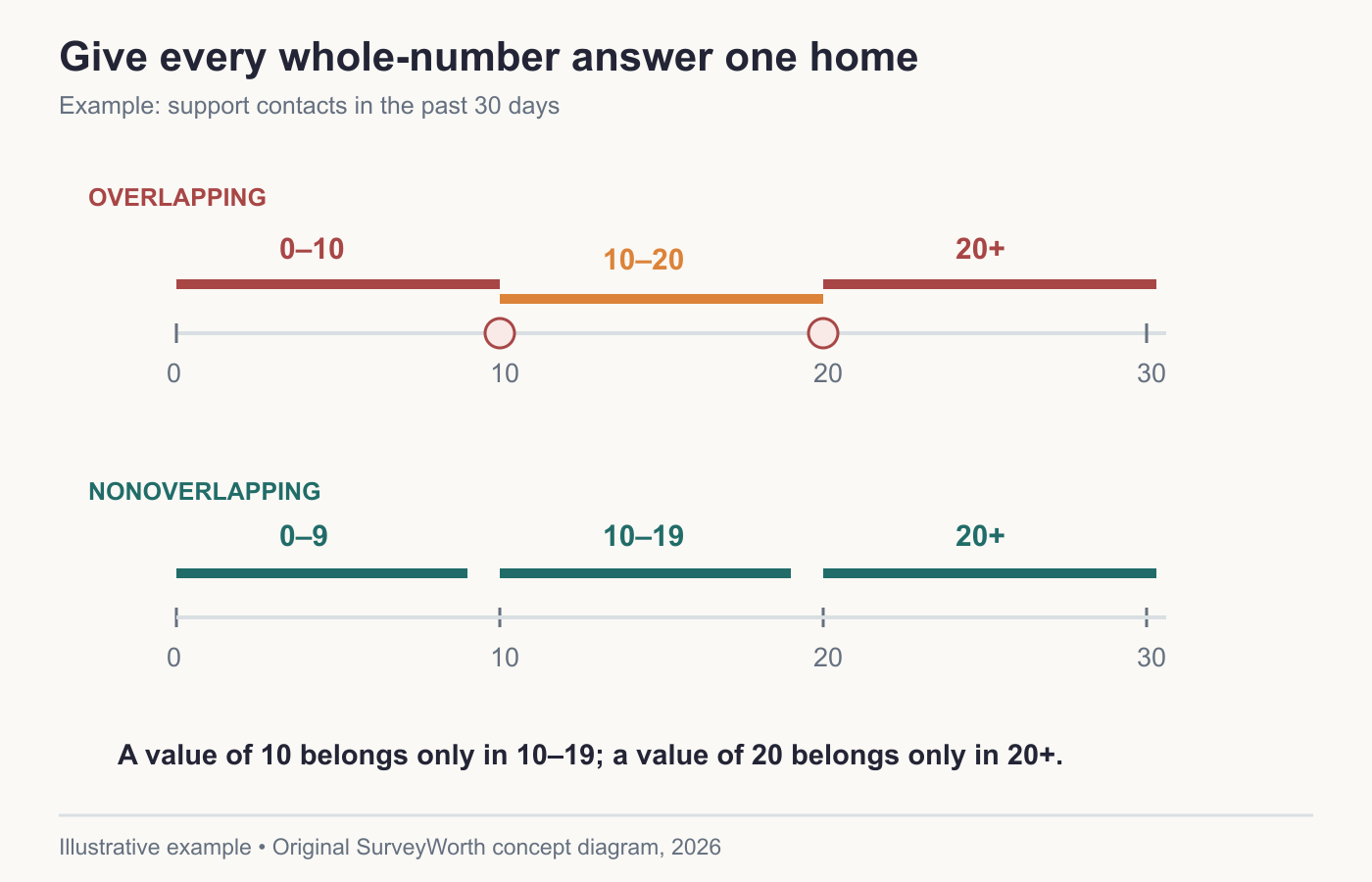
Image source: Original SurveyWorth conceptual diagram, 2026. Illustrative, not observed data or a product screenshot. Based on “Balance answer choices and labels”.
| Draft | Hidden assumption | Revision |
|---|---|---|
| “Why was checkout frustrating?” | Checkout was frustrating. | “How, if at all, did checkout affect your purchase?” |
| “Which of our excellent features helped most?” | All features were excellent. | First ask which features the person used; then ask “Which of those features, if any, helped you most?” |
| “How satisfied were you with price and delivery?” | One answer can cover two experiences. | Ask “How satisfied were you with the price?” and, after delivery, “How satisfied were you with the delivery experience?” as separate items. |
In a pilot, have participants explain what they think each answer option means and identify any missing or overlapping choice. Pew Research Center’s question-writing guidance stresses that even small wording changes can alter responses. Keep a versioned record of the original item, revision reason, and affected reports. The question-order guide covers priming across items, which sentence editing alone cannot solve.
Ask the last-event question before the opinion
A vague “Do you usually have trouble?” invites a summary shaped by memory and mood. “Think of the last time you tried to pay on this site. What happened?” anchors the answer to an event; a follow-up can ask whether a problem occurred. Typeform’s biased-question examples show the effect of loaded premises, while Jotform’s guide to unbiased survey questions offers alternative wording patterns. Pilot with people who succeeded and people who failed, because a question written only for failure cases can make success hard to report. Keep “not applicable” where someone did not encounter the step. The analysis then has a valid eligibility route and a clearer outcome.
Frequently asked questions
Is “Why?” always a bad question?
No, but it can imply blame. “What influenced your decision?” often invites a more useful answer.
Should every question be required?
Only when necessary. Forced answers to irrelevant or sensitive items can increase inaccurate responses and exits.
Choose tools for your next survey.
Explore survey creation software and research tools for your project.
Explore survey softwareKeep reading.

How to Test a Marketing Campaign With Surveys
Use surveys before, during, and after a campaign to test message clarity and track audience response without overclaiming causality.
Read the guide
How to Measure Brand Awareness With a Survey
Measure unaided recall and aided recognition with balanced survey questions and careful sampling.
Read the guide
How to Design a Product Testing Survey
Write product concept, prototype, and post-launch survey questions that fit what participants have actually experienced.
Read the guide