
How to Test a Marketing Campaign With Surveys
Use surveys before, during, and after a campaign to test message clarity and track audience response without overclaiming causality.

Campaign surveys can help a team choose a clearer message, find confusion while an ad is live, and learn what the intended audience remembers afterward. The research question changes at each stage, so the questionnaire should change too.
Write a separate question for each campaign stage
Before launch, the question is whether the message communicates the intended offer to the intended audience. During the campaign, the question may be whether exposed people understand the next step and whether the landing page matches the ad. Afterward, the question may be whether awareness or recall changed. Treating all stages as “Did people like the ad?” misses the decisions a campaign team can make.
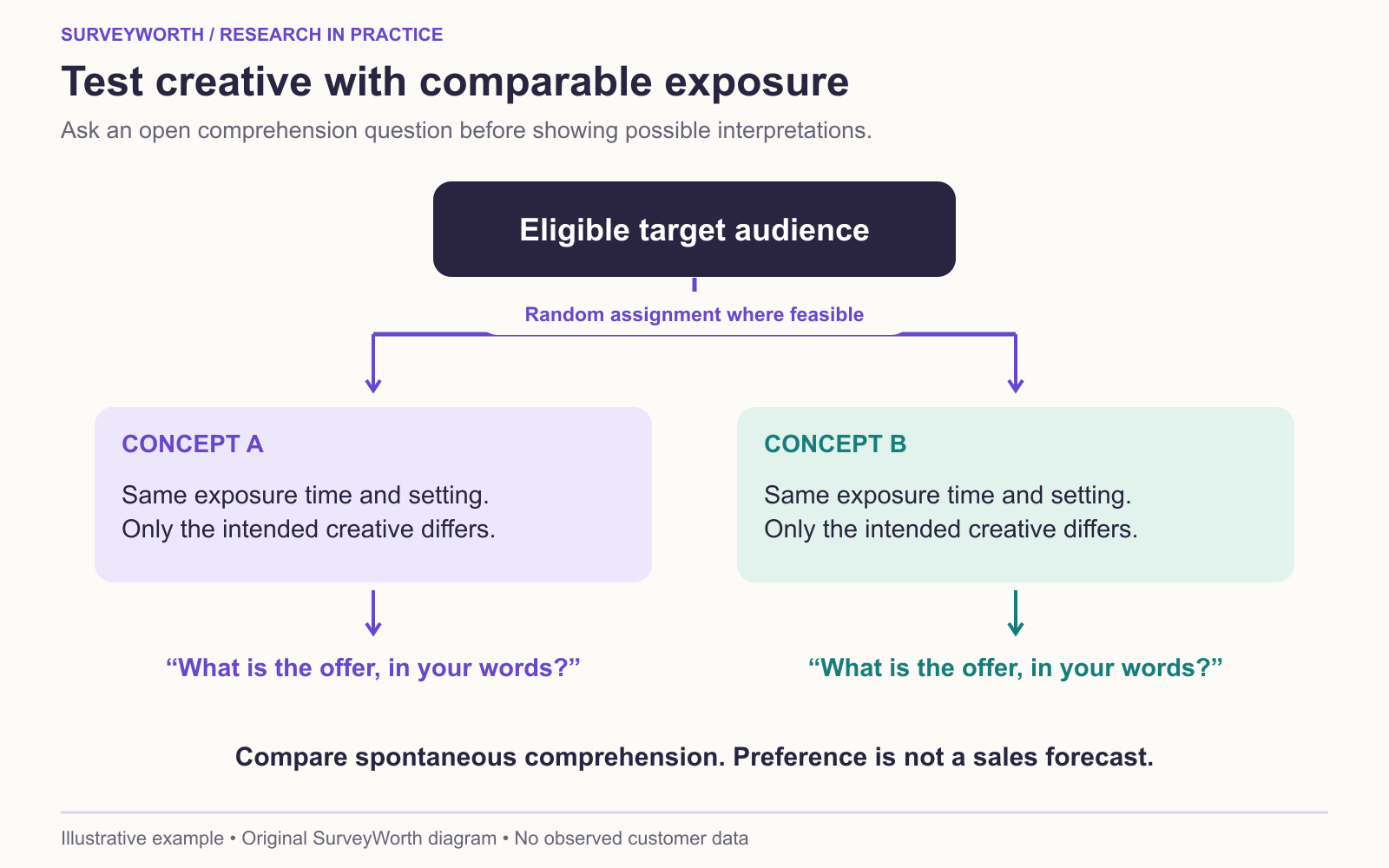
Image source: SurveyWorth original conceptual diagram, 2026. Based on “Separate a creative test from a campaign-effect estimate” in this guide. Illustrative example; no observed survey data or official product screenshot.
For a concept test, show a realistic version of the creative. Ask respondents to describe in their own words what the offer is and who it is for before presenting a list of possible interpretations. Then ask what remains unclear or unconvincing. This order reveals spontaneous comprehension. If you compare two concepts, keep exposure, timing, and question wording comparable and avoid showing the same person both in a fixed order without considering carryover.
Test the complete journey
An ad can be clear while the landing page is not. Ask participants to move from the message to the page and attempt the intended task. A short survey can capture the reason for hesitation; a usability session can reveal where they actually struggle. Compare these findings with click-through and conversion data, but remember that a click is not proof of understanding or satisfaction.
If the campaign is already live, recruit people who plausibly saw it and record exposure source. Self-reported exposure is imperfect: people may confuse similar ads or forget a brief impression. Use campaign delivery data where appropriate, while respecting privacy commitments. Do not treat a survey of clickers as the opinion of everyone exposed.
Measure after launch with a stable baseline
Use the same category and brand-awareness questions before and after the campaign if you want a trend. Keep sampling and field timing as comparable as possible. A post-only question such as “Did this campaign make you more likely to buy?” is vulnerable to memory and social-desirability bias. It can provide a directional reaction, but it does not measure incremental sales.
An illustrative report might say: “In concept testing, many target respondents understood the core promise but confused the trial terms. We clarified the terms before launch. After launch, aided recognition rose in our sampled audience; we cannot attribute all of that change to the campaign.” That separates a concrete design learning from an uncertain causal claim.
Choose an action from each result
If people misunderstand the offer, revise the message. If they understand the ad but stall on the landing page, test that page. If awareness rises without qualified visits, inspect targeting and call-to-action. If the team needs to know incremental impact, plan an experiment or holdout before launch when feasible. A survey is one part of the measurement system, not the entire campaign scorecard.
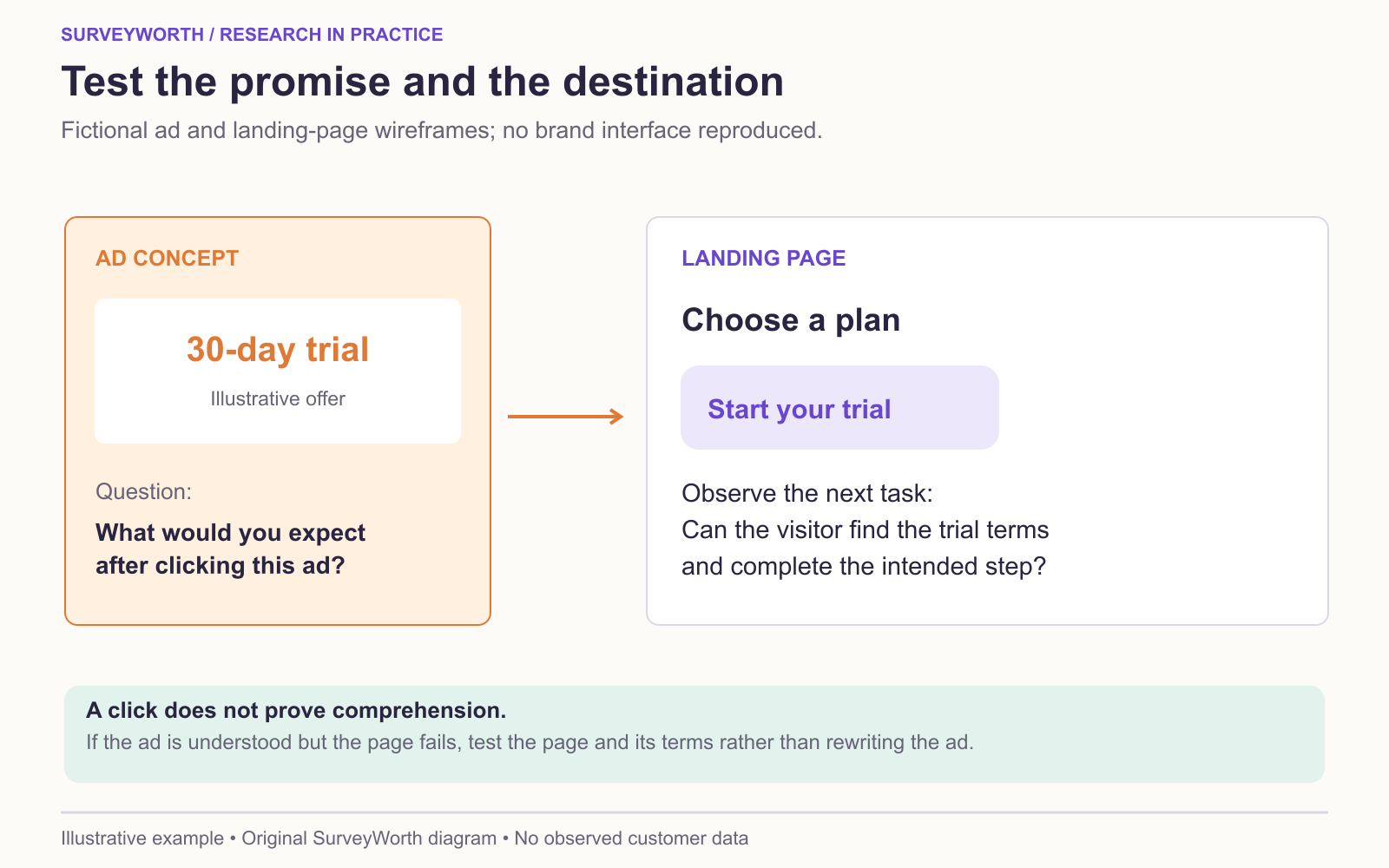
Image source: SurveyWorth original conceptual diagram, 2026. Based on “Test the complete journey” in this guide. Illustrative example; no observed survey data or official product screenshot.
Separate three campaign decisions
QuestionPro’s campaign-survey guide organizes questions before, during, and after launch; its brand-awareness guide distinguishes recall from recognition. Use that timing to assign a different decision to each stage. Before launch, expose comparable participants to alternative messages and ask what each means. During delivery, check whether the intended audience saw and understood the message. Afterward, estimate awareness or behavior against a credible comparison, not simply a pre/post chart.
| Stage | Question | Evidence for action |
|---|---|---|
| Prelaunch | What did the message say in the respondent’s words? | Rewrite misunderstood copy. |
| In market | Was exposure logged, recalled, or both? | Diagnose placement and attention separately. |
| Postlaunch | Did awareness change beyond a comparable baseline? | Investigate incrementality. |
A better click-through rate after a headline test does not, by itself, identify the survey as the cause. A campaign-effect analysis also needs a credible account of what would have happened without the campaign. Report the sampling route, timing, exposure definition, and competing campaigns beside the result. The brand-awareness guide supplies an unprompted-to-prompted question sequence.
Write the causal sentence last
A survey may show that people who remember an ad also report higher purchase intent. Those people might have liked the brand before seeing the ad. Typeform’s discussion of feedback limits helps separate reported experience from an effect claim, and AAPOR’s reporting guidance requires the fieldwork detail needed to assess group comparability. Put the design beside the number: how the exposed and comparison groups were formed, when outcomes were measured, and what else changed. If those details are unavailable, write “awareness was higher among respondents who recalled the ad” rather than “the campaign increased awareness.” The latter needs a credible counterfactual.
Separate a creative test from a campaign-effect estimate
Before launch, randomize eligible participants between two creative concepts where feasible and ask the same comprehension and message-takeaway items after exposure. Keep exposure time and context similar. This can help choose clearer creative, but stated preference is not a sales forecast.
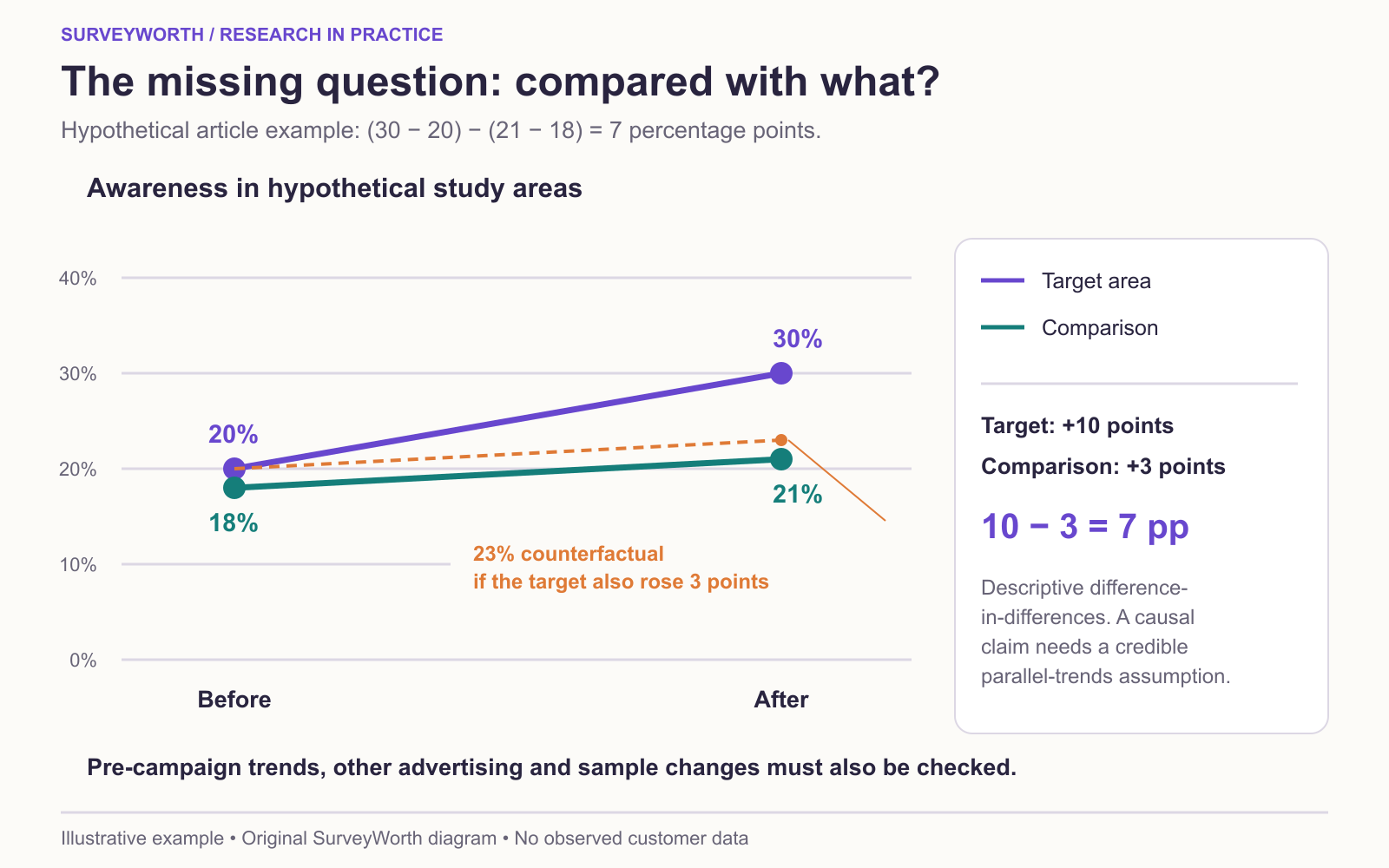
Image source: SurveyWorth original conceptual diagram, 2026. Based on “Separate a creative test from a campaign-effect estimate” in this guide. Illustrative example; no observed survey data or official product screenshot.
To estimate campaign effects after launch, consider a preplanned exposed-versus-comparable-unexposed design or a pre/post measure with a credible comparison group. For a simple hypothetical illustration, awareness rises from 20% to 30% in a target area and from 18% to 21% in a comparable unexposed area. The descriptive difference-in-differences is (30−20)−(21−18) = 7 percentage points. It is only a causal estimate if the comparison group represents the trend the target group would have followed without the campaign. That parallel-trends assumption cannot be proved from the post-campaign survey alone; inspect pre-campaign trends and document seasonality, concurrent advertising, and sample-composition changes.
Ask unaided ad or brand recall before any branded recognition list. Record whether exposure is a logged impression or self-reported recall: an impression does not establish attention, while recalled exposure can reflect prior brand interest or survey prompts. Put the design limitation beside the effect estimate, not only in a footnote.
Choose tools for your next survey.
Explore survey creation software and research tools for your project.
Explore survey softwareKeep reading.

How to Measure Brand Awareness With a Survey
Measure unaided recall and aided recognition with balanced survey questions and careful sampling.
Read the guide
How to Design a Product Testing Survey
Write product concept, prototype, and post-launch survey questions that fit what participants have actually experienced.
Read the guide
How to Find Unmet Customer Needs With Market Research Surveys
Discover unmet needs by surveying real tasks, workarounds, priorities, and failed outcomes instead of asking for feature wish lists alone.
Read the guide