
Email, SMS, Social Media, or Website: Where Should You Share a Survey?
Choose survey distribution channels by audience, context, response quality, and the kind of inference you need.
The best distribution channel is the one that reaches the people who can answer your question at the right moment. Email, SMS, social media, and website invitations have different coverage and interruption costs.
Evaluate channels against four criteria
Coverage: Does the channel reach the people in the target population? Timing: Can it ask close to the experience without interrupting it? Context: Will respondents know what event the survey refers to? Traceability: Can you document invitations, starts, and duplicates? A channel that is inexpensive but misses the relevant audience may be more costly than a targeted one.
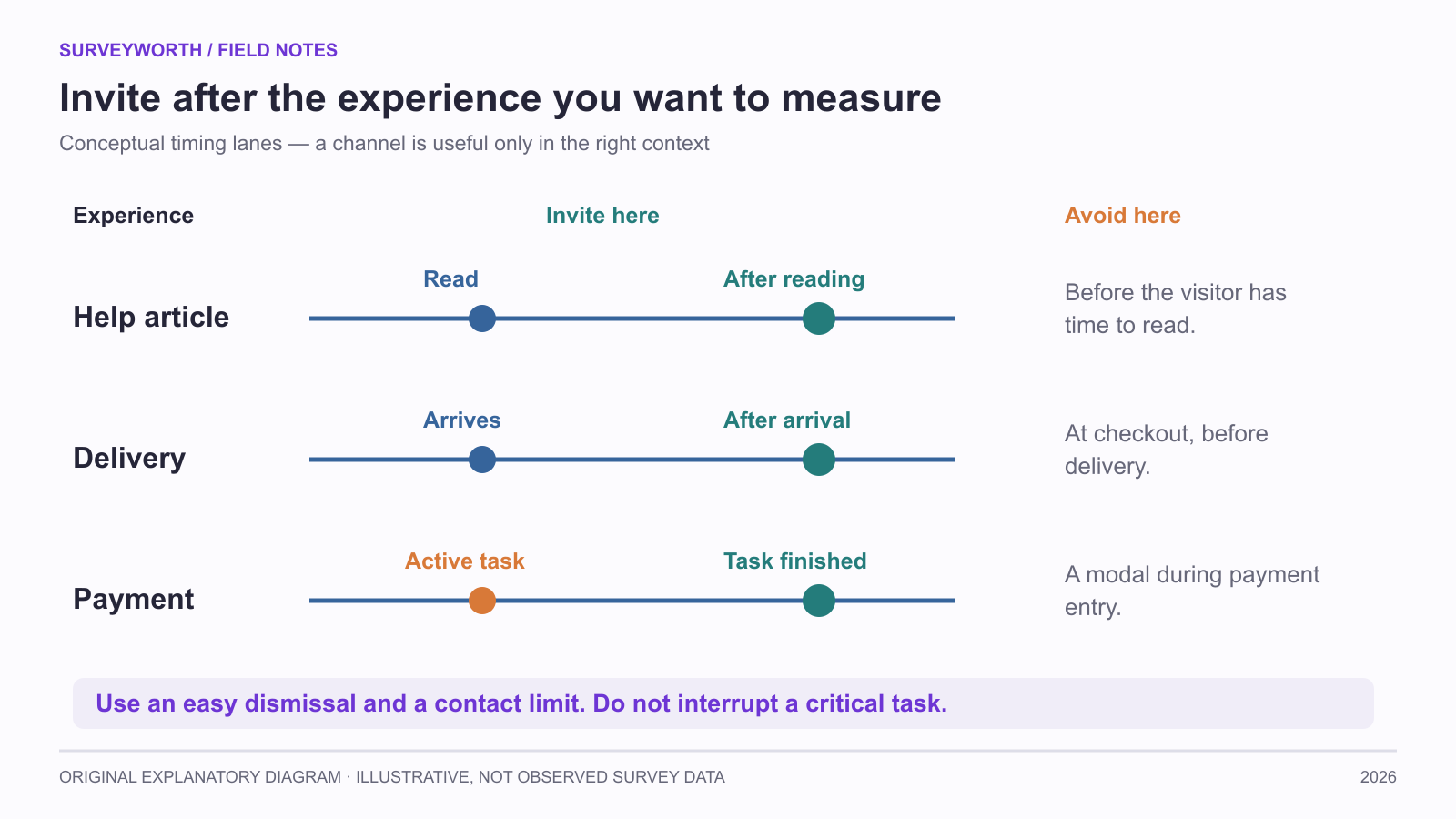
Image source: SurveyWorth original explanatory diagram, 2026. Illustrative, not observed survey data. Based on this article’s “Evaluate channels against four criteria; Match the channel to a concrete question” section(s); not a product screenshot.
Email works well for known customers and longer invitations because it can provide context. Its weaknesses include stale addresses, filtering, and a population limited to people whose email you hold. SMS can be timely and easy to open on a phone, but the message must be concise and the form must truly work on mobile. Social media is useful for quick exploratory input or community engagement, but platform algorithms and self-selection make population claims difficult. A website intercept reaches people in the middle of a journey, while excluding those who never visited or left before the trigger.
Match the channel to a concrete question
Suppose the decision is whether a help article needs a rewrite. An unobtrusive prompt after a visitor has had time to read the page may collect immediate task feedback. A broad email to all customers would add noise because many never used the article. If the decision concerns a delivery experience, a message to recent recipients after delivery is more relevant than a generic website popup.
For a brand-awareness study of U.S. category buyers, a social post from the brand will overrepresent people already aware of it. A research sample designed to include nonfollowers is needed. The best channel is therefore not a universal ranking; it depends on the claim you intend to make.
Combine channels without losing meaning
When several channels are necessary, use the same core wording and record the channel for each response. Check whether one person can answer through both email and the website. Deduplicate in a way consistent with the privacy promise. Compare results by channel before pooling: a current customer responding to email and a first-time site visitor may be describing different experiences. If their answers differ, that difference may be a substantive finding rather than a nuisance to average away.
A QR code in a store or on packaging is a distribution route, not a sampling method. Its audience is whoever sees and chooses to scan it. Place it where the relevant experience has occurred and make the destination clear before someone scans.
Build a channel plan before fieldwork
Write one row per route with the audience, trigger, expected exposure base, invitation limit, and evidence it can produce. For a post-delivery study, the customer email list might cover orders with a confirmed delivery date. A QR code on packaging reaches only people who open the package and choose to scan. Those responses may describe different stages even if both forms ask “How was delivery?” Decide in advance whether to report them separately.
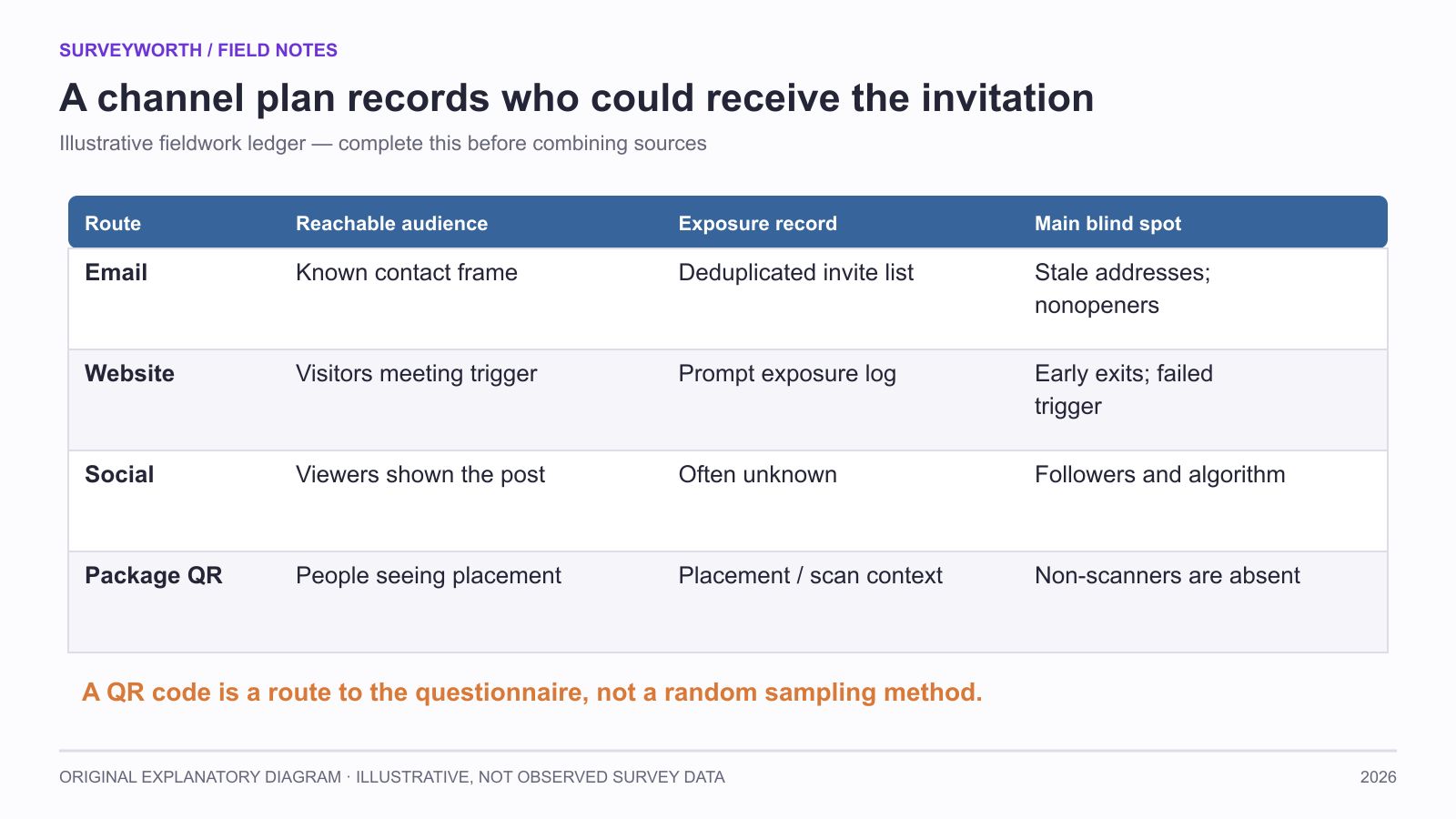
Image source: SurveyWorth original explanatory diagram, 2026. Illustrative, not observed survey data. Based on this article’s “Build a channel plan before fieldwork; Combine channels without losing meaning” section(s); not a product screenshot.
When comparing channels, hold the core question and answer choices stable. Record when the invitation was sent and whether the respondent had completed the relevant task. A low completion count from SMS could reflect a difficult mobile form; a high response count from social media could reflect a vocal audience rather than better coverage. Use qualified answers and missingness by route to judge the channel, then document any mid-field change. If the website prompt is moved from the help page to checkout, it reaches a new population and begins a new series.
Protect the user experience
Set frequency caps for intercepts and avoid presenting a request during a critical task such as payment. Make dismissal easy. For messages, follow the permissions and contact rules applicable to the channel and your relationship with recipients. In the report, state where and when each invitation appeared. Without that context, readers cannot judge what the responses describe.
Review channel friction
Before launch, click every invitation in the environment where it will appear. An SMS link may open a slow page; an email button may be hidden in dark mode; a QR code may lead to a login wall. These failures create a channel-specific selection effect because only the most determined people continue. Test the full route and use the same final survey version across channels when comparing results.
Treat every route as a different sample
Typeform’s distribution guide compares email, social, SMS, and website prompts. Start by defining the target audience and the decision the survey must support. The question is not “Which channel gets the most clicks?” but “Which route gives eligible people a known chance to answer?” Email to a customer frame can support a defined invitation denominator. A public social link usually cannot. A website intercept can capture immediate context but excludes people who leave before the trigger.
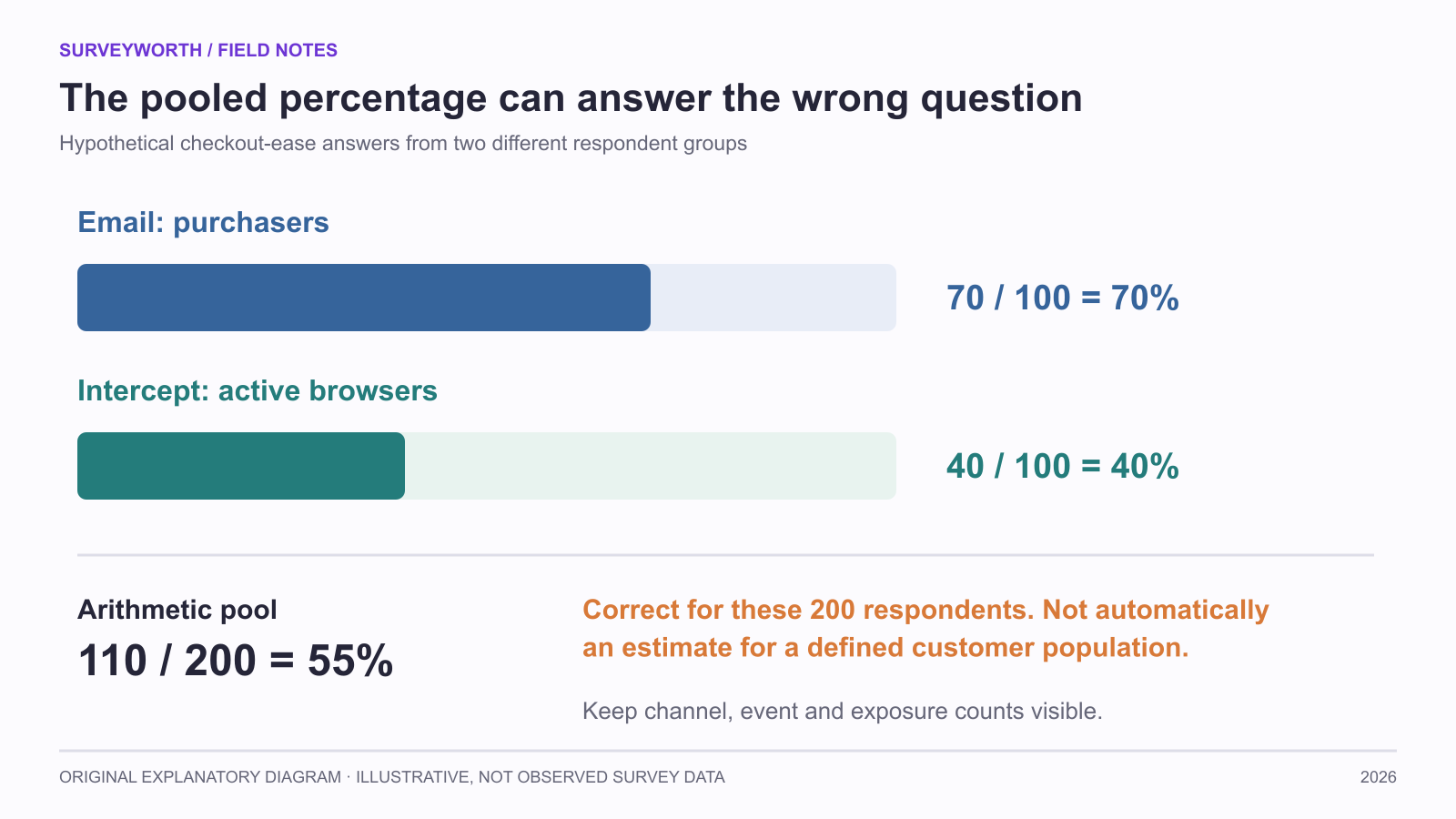
Image source: SurveyWorth original explanatory diagram, 2026. Illustrative, not observed survey data. Based on this article’s “Treat every route as a different sample; Avoid a false combined percentage” section(s); not a product screenshot.
| Route | Know who was invited? | Main selection risk | Useful claim |
|---|---|---|---|
| Customer email | Usually, if records are deduplicated. | Nonopeners differ. | Respondent experience in the invited frame. |
| Website intercept | Exposure can be logged. | Trigger misses early exits. | Feedback from eligible exposed visitors. |
| Social post | Usually no. | Followers and algorithm self-select. | Ideas to investigate. |
| QR code | Usually no; placement counts do not identify who saw the invitation. | Only people who encounter and choose to scan it respond. | Feedback from respondents reached through the documented placement. |
Alchemer’s QR-code article describes that route’s practical constraints; the location and exposure base still belong in your own study log. Keep source on each record and compare groups before pooling. See the sampling guide for the boundary between exploration and population inference.
Avoid a false combined percentage
Suppose 70 of 100 email respondents and 40 of 100 intercept respondents say checkout was easy. The pooled 55% is mathematically correct for those 200 respondents, but it does not represent a defined customer population if email reaches purchasers and the intercept reaches active browsers. Typeform’s sampling-method guide explains why selection governs inference, and QuestionPro’s intercept guide shows how triggers shape the exposed group. Report each 70/100 and 40/100 result with invitation or prompt exposure counts, then investigate why they differ. Combine only if the decision calls for that mixture and its weighting is justified.
Choose tools for your next survey.
Explore survey creation software and research tools for your project.
Explore survey softwareKeep reading.

How to Test a Marketing Campaign With Surveys
Use surveys before, during, and after a campaign to test message clarity and track audience response without overclaiming causality.
Read the guide
How to Measure Brand Awareness With a Survey
Measure unaided recall and aided recognition with balanced survey questions and careful sampling.
Read the guide
How to Design a Product Testing Survey
Write product concept, prototype, and post-launch survey questions that fit what participants have actually experienced.
Read the guide