
How to Recruit the Right Survey Respondents
Define eligibility, write fair screening questions, and recruit survey respondents through channels that fit your target audience.

The right respondents are the people whose experience can answer your research question. A large number of unrelated responses does not fix a poor match between audience and decision.
Build an audience specification
An audience specification has inclusion and exclusion rules, a target geography, a relevant time period, and any planned subgroups. For a study of first-time online shoppers, “people who made their first purchase from us in the last 60 days” is more useful than “customers.” If the decision concerns people who did not purchase, a customer list cannot supply the full audience. Write this specification before choosing a convenient channel.
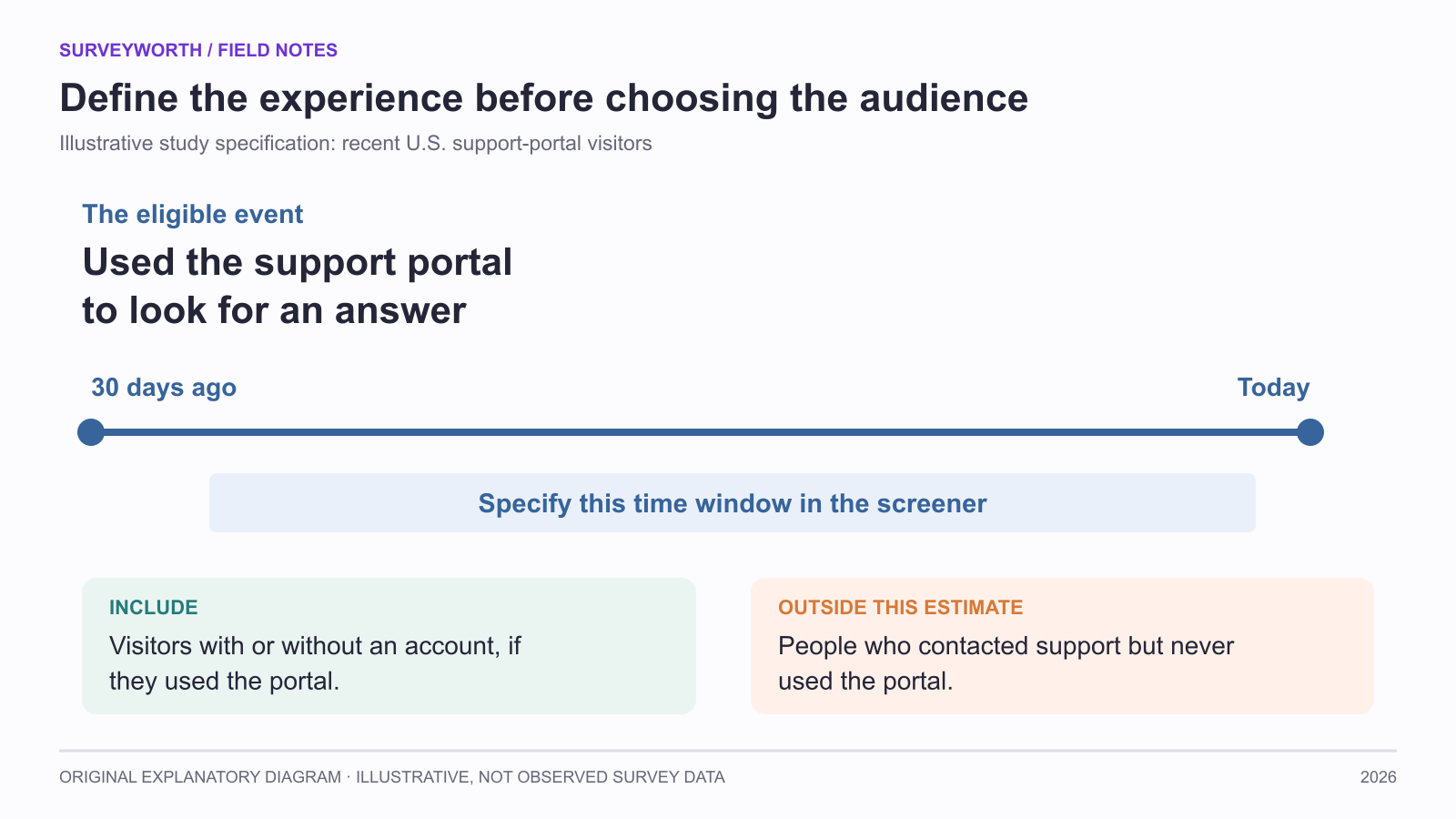
Image source: SurveyWorth original explanatory diagram, 2026. Illustrative, not observed survey data. Based on this article’s “Build an audience specification; A neutral screener and invitation” section(s); not a product screenshot.
Also decide whether participants need to represent a population or simply provide diverse relevant experiences. Those are different recruitment tasks. A probability-based estimate needs an appropriate frame and selection process. An exploratory study may recruit purposively to include both successful and unsuccessful users. Do not describe both as the same kind of sample.
Choose channels based on coverage
A customer database can reach verified users but excludes noncustomers and people with outdated contact information. An on-site prompt reaches visitors at a moment of experience but may miss those who leave before the trigger. Social media reaches followers and people the platform shows the post to; it is highly self-selected. A panel can help locate a niche audience, but assess how members were recruited, screened, and incentivized. Community organizations can reach people outside your existing brand audience, provided the request is relevant and respectful.
If you use multiple channels, record the source for each response. Check whether the same person may receive several invitations. Deduplication methods must fit your privacy promise, especially if the survey is called anonymous.
Plan the sample mix and stop rule
If the analysis needs first-time and returning users, set target numbers for both before fielding. Do not fill only the easier group and then compare tiny segments. Record invitations, eligible starts, completes, and exclusions by channel. A final report should state how respondents were found, who was missing, and which claims the sample can support. Recruitment quality is part of research quality, not a separate logistics problem.
Write the invitation for the intended participant
A recruitment message should make the experience relevant without telling people which answers qualify. State who is conducting the research, the general topic, realistic time commitment, privacy approach, and incentive terms. For an invitation to recent buyers, “Help us understand the ordering experience” is clearer than “Tell us why checkout failed” because many buyers did not encounter a failure. If the survey is sent through a partner or community, explain that relationship so the request is recognizable.
Monitor recruitment while it is happening
Create a fieldwork table by channel and target group: invitations, clicks, eligible starts, completions, and exclusions. If one channel yields mostly ineligible people, revise the channel rather than loosening criteria after seeing the answers. If a subgroup is filling slowly, increase outreach to that group under the original plan. Keep a record of changes so readers can judge whether the final sample was shaped by the data already collected. Close recruitment when the predefined target or stop rule is met, not simply when the desired result appears.
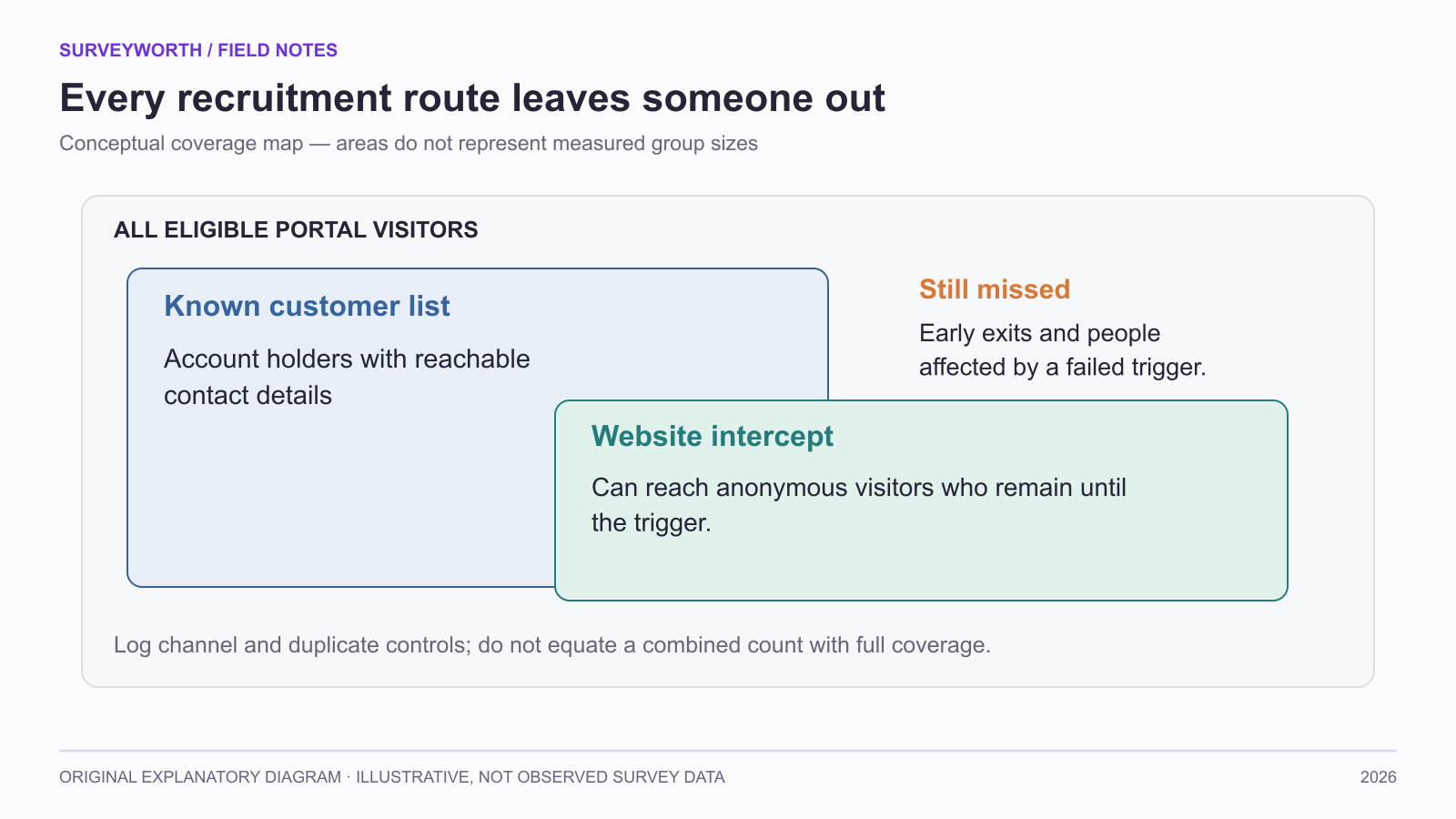
Image source: SurveyWorth original explanatory diagram, 2026. Illustrative, not observed survey data. Based on this article’s “Choose channels based on coverage; Document who could not participate” section(s); not a product screenshot.
Document who could not participate
If the invitation is English-only, requires a smartphone, or is open only to email subscribers, note that in the research record. These constraints may be acceptable for the decision, but they define the boundary of the evidence. If a missing group is central to the decision, add a suitable recruitment route or narrow the conclusion. A good sample description includes exclusions, not only the people who completed.
A neutral screener and invitation
For a hypothetical study of recent U.S. support-portal visitors, a screener could ask: “In the past 30 days, have you used the support portal to look for an answer?” with Yes / No / Not sure. Follow with “Which of these best describes your role?” only if the study has a predeclared role requirement. Do not say that a particular answer qualifies or ask respondents to claim an experience they did not have.
An invitation can read: “We are studying how customers find help information. If you used our support portal in the past 30 days, you may be eligible for a short survey. The tested completion time is [insert measured pilot time]. Participation is optional. We will use answers to prioritize changes to support content and navigation. [Accurate privacy and incentive terms here.]” Replace the bracketed timing and terms with verified facts before sending; do not publish the placeholder text. Log invitation source, eligibility, starts, completions, and quota closures by channel. If only email subscribers were invited, do not describe the result as representing all U.S. customers.
Work backward from the people you might miss
Existing lists, panels, social channels, and communities reach different groups. Typeform’s screener guide turns eligibility into neutral questions rather than telling people which answer qualifies. For a U.S. support-portal study, define the eligible event first, then make a coverage table: account holders with a logged visit, visitors without an account, people who contacted support instead, and people whose issue was solved without opening the portal. Only the first two belong in a portal-visitor estimate; the others may matter for a broader support study.
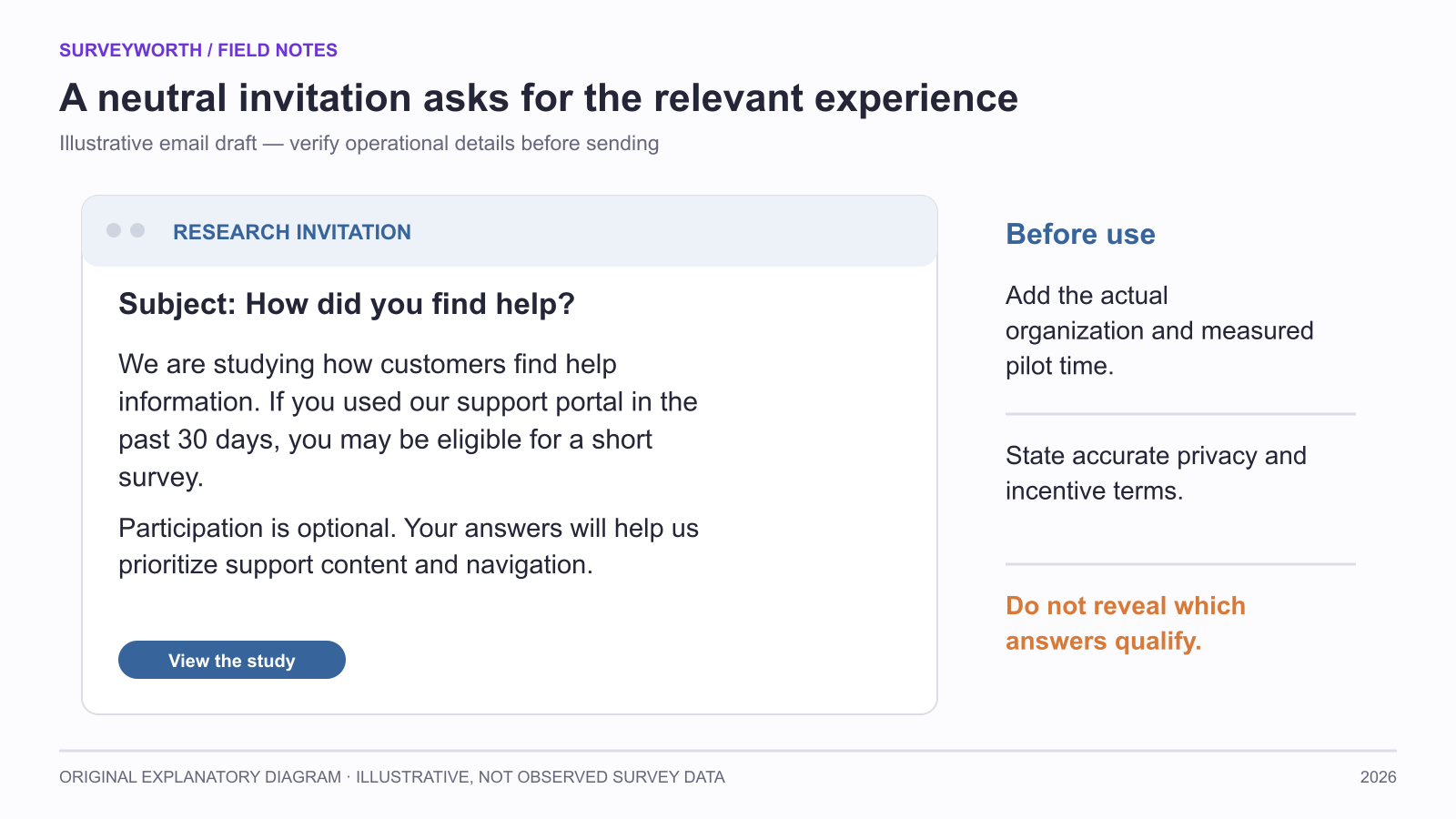
Image source: SurveyWorth original explanatory diagram, 2026. Illustrative, not observed survey data. Based on this article’s “Write the invitation for the intended participant; A neutral screener and invitation” section(s); not a product screenshot.
Record invitations, screen-outs, quota closures, starts, and valid answers for each source. A public social link cannot yield a reliable invitation denominator. If a panel is used, check how its members were recruited and whether duplicate membership across channels is possible. Jotform’s market-research collection overview is useful for channel comparison, but the project’s own sample frame determines inference. An invitation should describe the actual pilot-tested time and privacy terms. The sampling guide explains why a large pool of volunteers does not by itself represent U.S. customers.
Document why the final sample differs from the plan
If mobile users are invited less often because the intercept fails on small screens, a later weighting adjustment cannot fully establish what those missed users would have said. Typeform’s target-audience article distinguishes the population from the people actually reached; Alchemer’s mobile QR discussion illustrates how a channel creates its own access requirements. Record each deviation: quota closed early, one email domain bounced, a device failed, or a panel segment was replaced. Report planned and achieved counts separately. Recruit a supplementary group only if its selection process is described; do not silently blend it into the original sample.
Frequently asked questions
Should I pay respondents?
Compensation can recognize time, especially for a demanding study. Make the amount and eligibility clear and watch for duplicate or low-quality entries.
Can friends and coworkers be respondents?
Only if they meet the target definition and their relationship does not undermine the decision you are trying to make.
Choose tools for your next survey.
Explore survey creation software and research tools for your project.
Explore survey softwareKeep reading.

How to Test a Marketing Campaign With Surveys
Use surveys before, during, and after a campaign to test message clarity and track audience response without overclaiming causality.
Read the guide
How to Measure Brand Awareness With a Survey
Measure unaided recall and aided recognition with balanced survey questions and careful sampling.
Read the guide
How to Design a Product Testing Survey
Write product concept, prototype, and post-launch survey questions that fit what participants have actually experienced.
Read the guide