
Post-Purchase Survey Questions: What to Ask and When
Ask useful post-purchase questions at the right stage, from checkout to delivery and early product use.
A post-purchase survey should match what the buyer has actually experienced. Right after checkout, a customer can describe ordering. After delivery, they can describe shipping and packaging. After enough use, they can comment on product fit. Asking about stages the buyer has not yet experienced produces guesses.
Separate the purchase journey into stages
At checkout, a buyer can report whether prices, taxes, delivery estimates, and payment steps were clear. After delivery, they can report whether the package arrived as expected and whether communication helped. After initial use, they can report whether the product solves the problem they bought it for. These stages need different timing and questions. A single “post-purchase” form sent right after payment cannot measure product satisfaction.
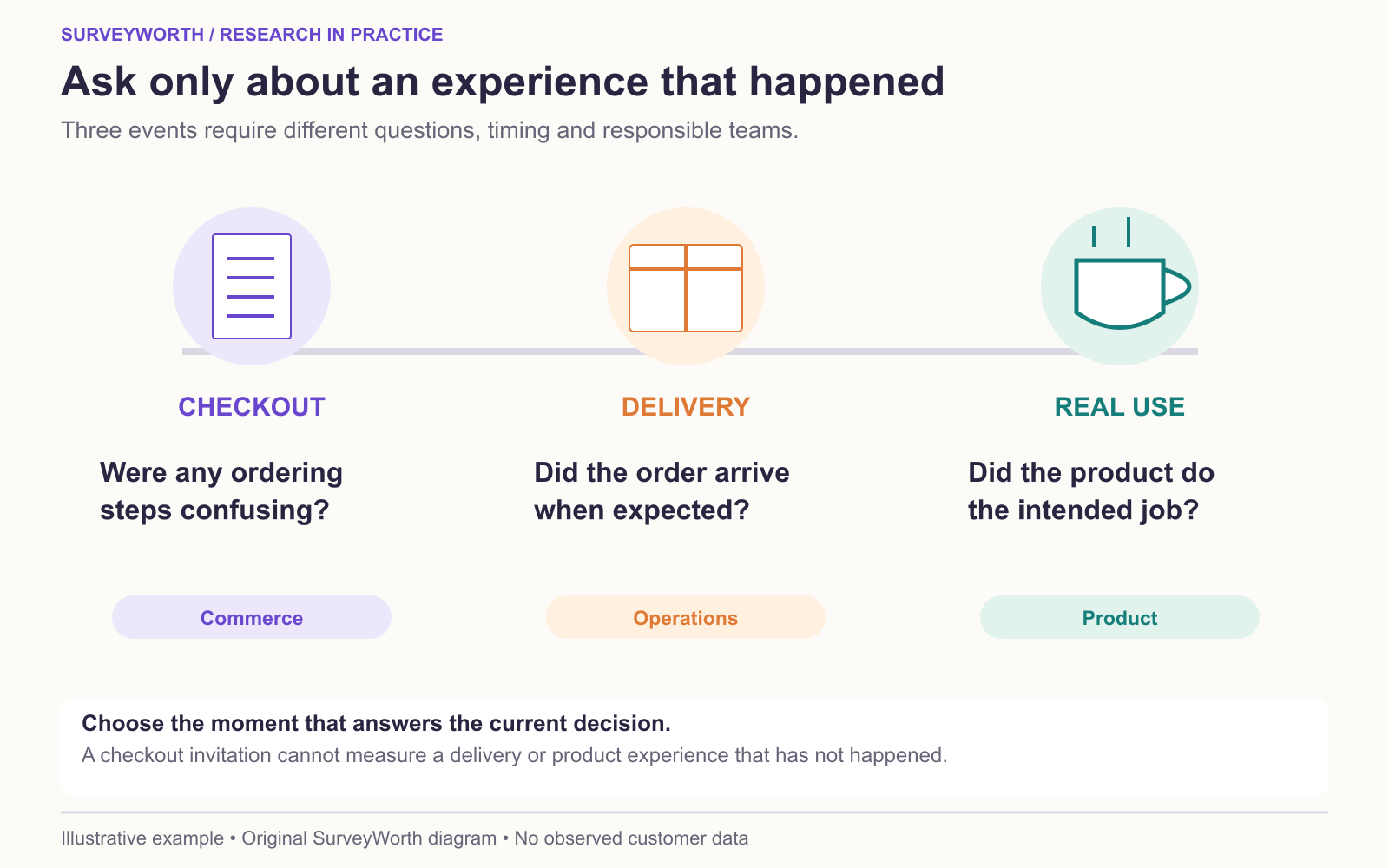
Image source: SurveyWorth original conceptual diagram, 2026. Based on “Separate the purchase journey into stages” in this guide. Illustrative example; no observed survey data or official product screenshot.
Create a contact plan so customers do not receive an invitation at every stage by default. Decide which stage matters to the current business decision and sample accordingly. For a product with a long setup period, allow enough time for real use; for a perishable item, the useful window may be short. Pilot the timing with customer interviews or operational knowledge rather than using an arbitrary day count.
Interpret feedback with transaction context
Where appropriate, compare reported delivery problems with actual delivery dates, order type, and support contacts. A customer may say a package was “late” because the estimate shown at checkout was unclear, even if the carrier met the recorded service target. That distinction suggests a communication fix rather than a logistics fix. Respect the privacy statement when joining survey answers to order data.
A negative response may warrant individual follow-up if the survey is confidential and the customer consented. For anonymous responses, use aggregate themes. Do not turn a product-feedback survey into an undisclosed marketing request. If you later want a testimonial, request separate permission for public use and attribution.
Turn a finding into a test
Suppose many respondents who received a product report confusion at first setup. Read the comments to locate the step, observe new customers using the instructions, revise the guide, and compare task success in a follow-up test. The survey gives direction; observation and behavior show whether the proposed fix works. Report the result with the relevant respondent base and stage.
Route each answer to the right owner
Jotform’s post-purchase question bank groups topics such as price, quality, use, and repeat purchase, while QuestionPro’s post-purchase overview distinguishes survey timing. A team should select one stage per invitation, not copy every suggested item. Immediately after checkout, cost clarity belongs to commerce; after delivery, a missing package belongs to support or operations; after use, a product-fit issue belongs to product. The question should say which event the respondent is rating.
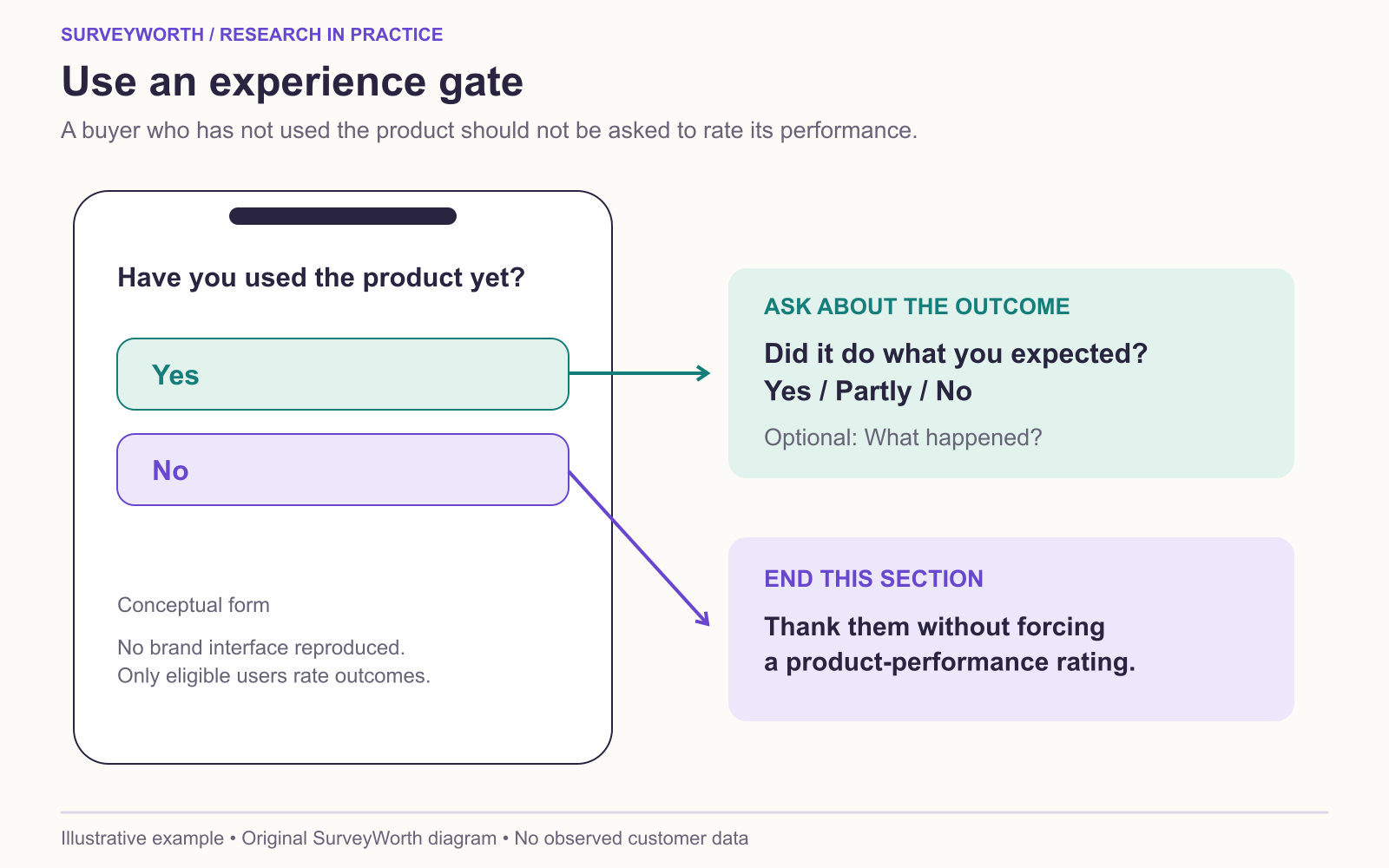
Image source: SurveyWorth original conceptual diagram, 2026. Based on “Three short templates tied to the event” in this guide. Illustrative example; no observed survey data or official product screenshot.
| Trigger | Core item | Owner if negative | Evidence to compare |
|---|---|---|---|
| Checkout complete | “Was the total cost clear before payment?” | Commerce | Price display and checkout path. |
| Delivery confirmed | “Did it arrive when expected?” | Operations | Promised and actual dates. |
| Product used | “Did it accomplish the job you bought it for?” | Product | Usage and follow-up task test. |
Typeform’s satisfaction-survey examples can inform a short follow-up, but a rating alone will not identify which team can fix the failure. Keep urgent service routing visible even if a person skips research questions. Record eligibility and item-answer bases by trigger; the satisfaction guide explains how to report a rating without blending stages.
Add a contact rule to protect the customer
A buyer who receives checkout, delivery, product, and support invitations in one week may ignore all four. Maintain a shared contact log with the trigger, team, eligibility, and last invitation date. Involve.me’s short-survey guidance supports keeping a request focused, while Typeform’s distribution guide covers timing and channel fit. Pick the stage whose answer will change a current decision; sample rather than invite everyone at every stage. If a service failure is reported, provide support without asking the customer to complete another survey. This protects both respondent experience and the interpretability of each stage’s answer base.
Three short templates tied to the event
Immediately after checkout: “Were any steps confusing before you placed the order?” — No / Yes / Not sure. If Yes: “Which step?” — Shipping / Payment / Promo code / Other, plus optional detail. Do not ask whether delivery was satisfactory before it happens.
After delivery: “Did the order arrive when expected?” — Earlier / On time / Later / Not sure. “Was anything missing or damaged?” — No / Yes. If Yes, route the respondent to support as well as keeping the research answer. “How satisfied were you with delivery?” — a fully labeled five-point scale. Add an optional explanation.
After enough product use: “Have you used [product] yet?” — Yes / No. If Yes: “Did it do what you expected it to do?” — Yes / Partly / No, then an optional explanation. If No, end without forcing a performance rating.
Choose the template that matches the team's decision and the customer's actual stage. Track which orders receive each invitation so several teams do not repeatedly ask the same person. In reporting, keep stage, eligibility, and item base separate; a delivery complaint and a product-use complaint call for different owners.
Report each stage with its own base
Suppose an illustrative order cohort contains 500 buyers. The checkout invitation reaches 300, 120 answer its first question, and 18 of those 120 report a confusing step. The useful statement is “18 of 120 respondents to the checkout item reported confusion (15%).” Also show the 300 invitations and 120 answers so readers can judge who is missing. Do not call 18 of 500 the checkout confusion rate: most buyers were not asked or did not answer.
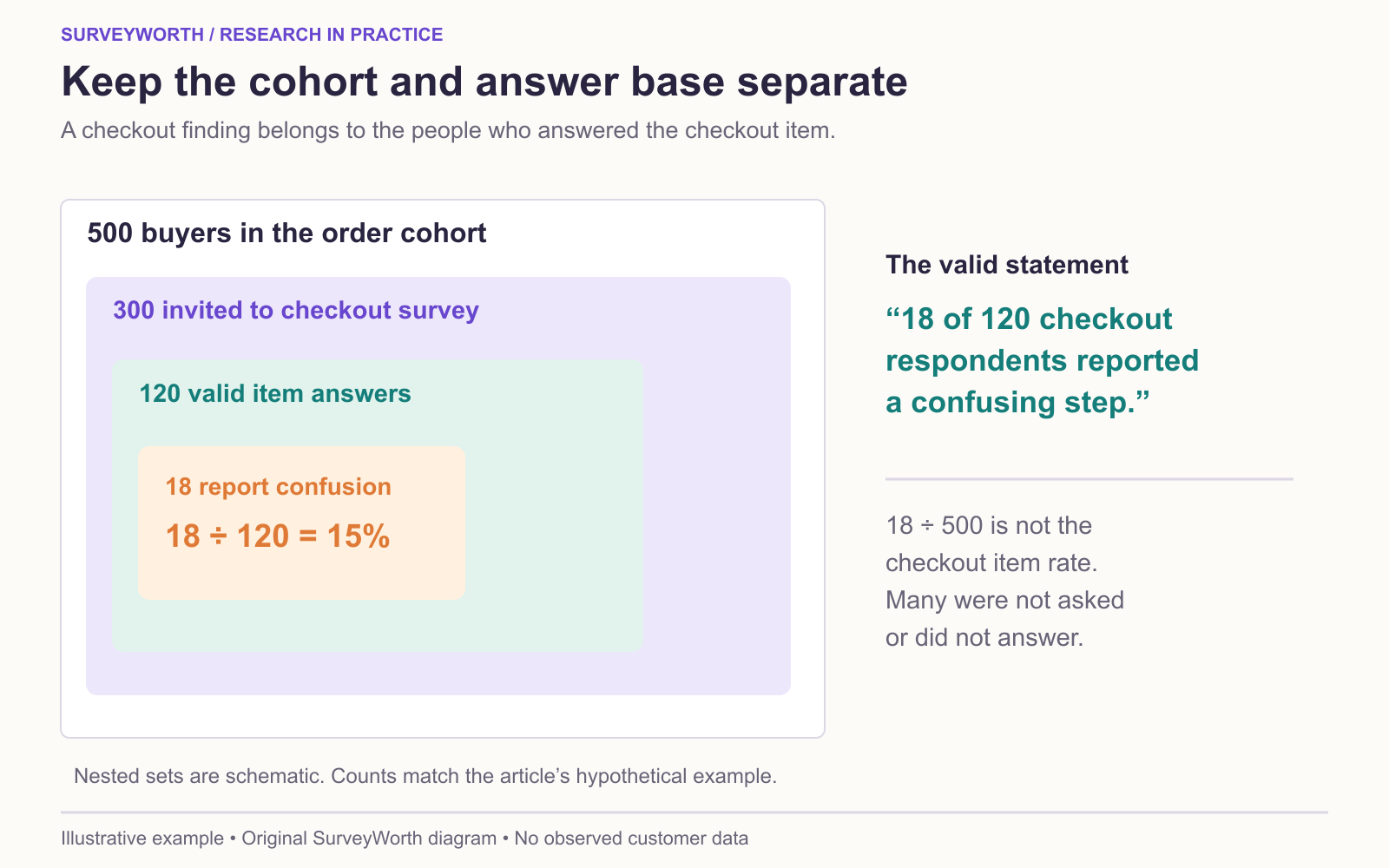
Image source: SurveyWorth original conceptual diagram, 2026. Based on “Report each stage with its own base” in this guide. Illustrative example; no observed survey data or official product screenshot.
A later delivery survey may reach a different subset, and product-use questions should include only respondents who have actually used the product. Report the eligible, invited, started, and item-answer counts for each stage. If the teams compare results over time, keep the invitation trigger and question wording stable or mark the break. This turns a collection of ratings into evidence that a delivery, checkout, or product team can act on without confusing one stage for another.
Frequently asked questions
When should I send a post-purchase survey?
After the specific experience you want evaluated, with enough time for the customer to have encountered it.
Can I ask for a public testimonial in the same survey?
Keep feedback collection separate from permission to publish a customer’s words or identity. Obtain clear, specific permission.
Can one invitation ask about every stage?
Only if every respondent has experienced those stages and the burden is justified. Usually a stage-specific invitation produces a clearer action.
Choose tools for your next survey.
Explore survey creation software and research tools for your project.
Explore survey softwareKeep reading.

How to Test a Marketing Campaign With Surveys
Use surveys before, during, and after a campaign to test message clarity and track audience response without overclaiming causality.
Read the guide
How to Measure Brand Awareness With a Survey
Measure unaided recall and aided recognition with balanced survey questions and careful sampling.
Read the guide
How to Design a Product Testing Survey
Write product concept, prototype, and post-launch survey questions that fit what participants have actually experienced.
Read the guide