
How Long Should a Survey Be? Set a Useful Completion Time
Decide survey length by research purpose and tested completion time, then cut questions that cannot support action.

There is no universal “right” number of survey questions. The useful limit is the time and effort your audience will reasonably spend for the value of the request. A five-question survey with dense grids can feel longer than a ten-question survey with simple choices.
Estimate burden rather than counting pages
A respondent experiences a survey as a sequence of decisions, reading, typing, and navigation. One matrix with 20 rows can take more time than ten simple choices. A required open response can dominate completion time. Branching means the same survey may last two minutes for one person and eight for another. Measure actual paths rather than dividing total questions by an assumed “seconds per question.”
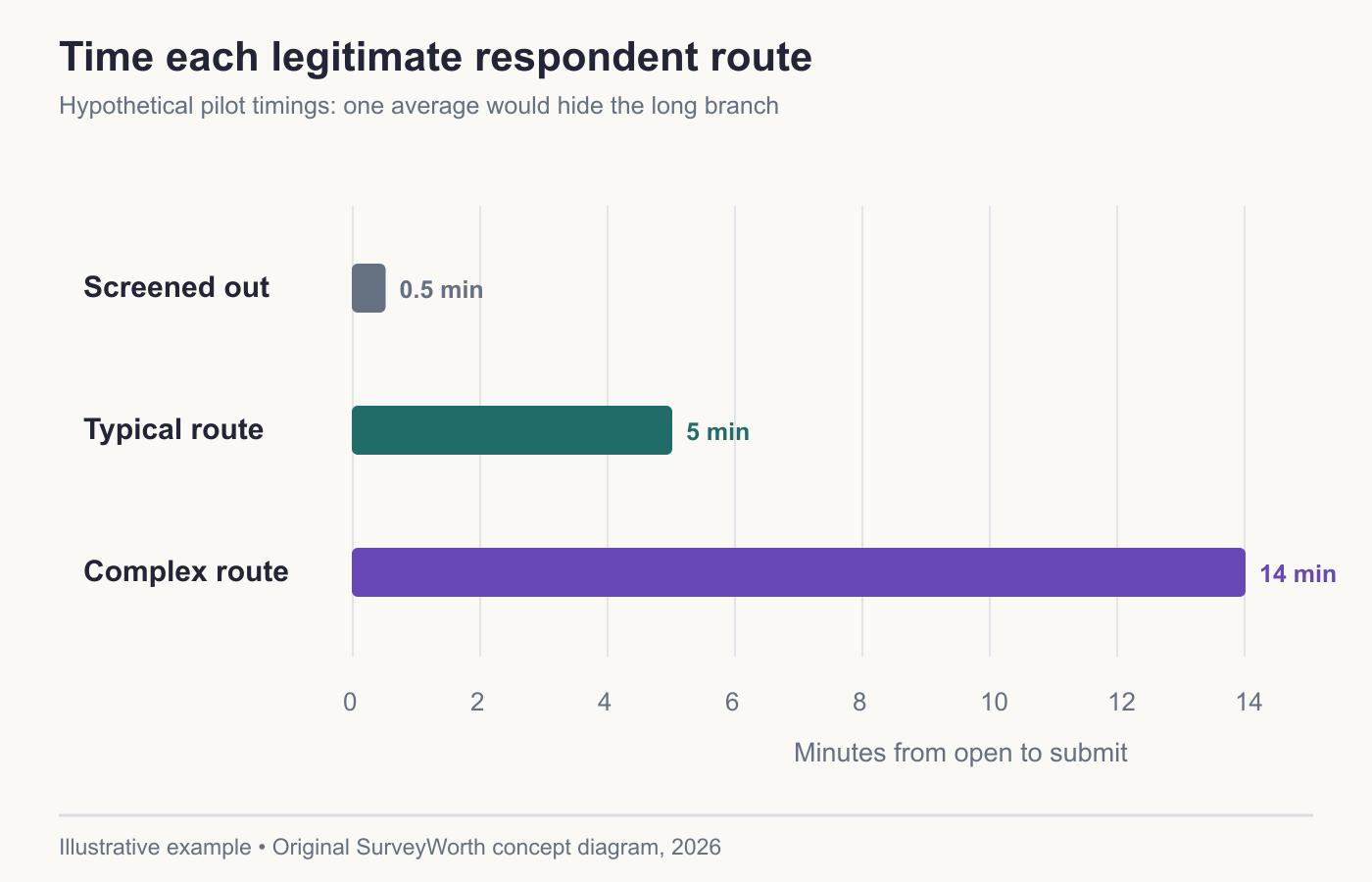
Image source: Original SurveyWorth conceptual diagram, 2026. Illustrative, not observed data or a product screenshot. Based on “Estimate burden rather than counting pages”.
Build a burden budget before launch. Label each item as a simple choice, a judgment requiring recall, a comparison task, or typed explanation. Then test with people who have not seen the draft. Record the median and slowest reasonable completion times on a phone, including reading the introduction and correcting an error. A realistic invitation can say “about five minutes” only after that estimate is supported by the pilot.
Remove low-value questions systematically
A stakeholder may want “just one more” item, but the accumulated cost falls on respondents. Ask what decision each item supports, whether that decision can be made from existing data, and whether the question is best answered by a survey. Basic account information already known to the organization may not need to be requested again. Do not collect demographic details merely because a template includes them.
A useful review table has three columns: question, decision it supports, and cost to the respondent. A high-cost item may still be justified if it is central. A low-cost item may still be removed if nobody will use its answer. This is more defensible than an arbitrary question-count target.
Design for interruptions
Mobile respondents may pause to answer a message or move between places. Keep instructions close to the question, do not rely on remembering details from several screens earlier, and save progress when your platform supports it and privacy promises allow it. Avoid a surprise essay at the end. If the final open question is optional, say so clearly.
Page-level drop-off should be interpreted with the path and eligibility rules. If many people exit at a screening question because they do not qualify, that is not evidence that the survey is too long. If eligible respondents leave at a long grid or a sensitive personal question, inspect that item. Compare completion by device and recruitment channel; a problem on phones may be a layout issue rather than a length issue.
A trimming example
Imagine a 15-minute post-purchase survey containing checkout, delivery, packaging, product quality, loyalty, and demographics. If the immediate decision is whether to improve delivery communication, keep the order-identification context, expected versus actual delivery, clarity of updates, and one optional explanation. Move product-quality research to a later, separately invited study. The shorter form is not merely easier to complete; its answers are tied to a clearer decision.
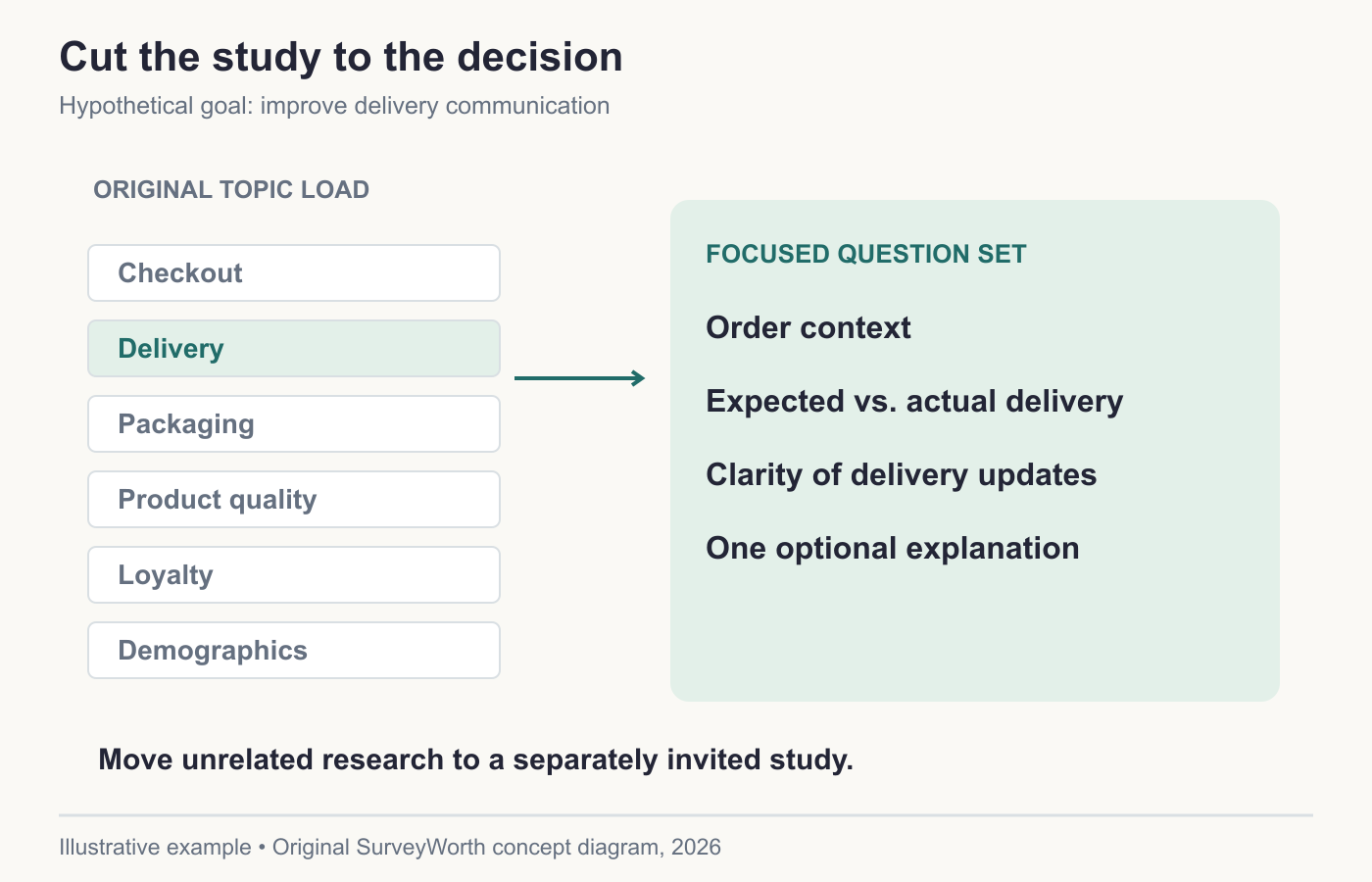
Image source: Original SurveyWorth conceptual diagram, 2026. Illustrative, not observed data or a product screenshot. Based on “A trimming example”.
When a longer survey is genuinely necessary, tell participants why, recruit for that level of effort, and compensate appropriately if the study design calls for it. Do not disguise a long research task as a one-click feedback request.
Treat length as an equity issue
A long survey can exclude people with limited time, slow connections, assistive-technology needs, or less familiarity with the topic. That changes who appears in the results. When trimming, look beyond average completion time: inspect who drops out and where. If a demanding study is necessary, recruit explicitly for it and compensate fairly where appropriate. Reducing burden can improve both participation and the range of perspectives you hear.
Diagnose time by route rather than one average
A length estimate is useful only if it comes from the version people will actually see. Involve.me’s survey-length guidance ties shorter forms to a focused objective, and its account of incomplete surveys lists friction beyond the number of questions. Pilot at least the shortest and longest legitimate branch, on a phone and a larger screen. Time from opening to submit, but also record pauses, skipped items, and whether participants had to look up information.
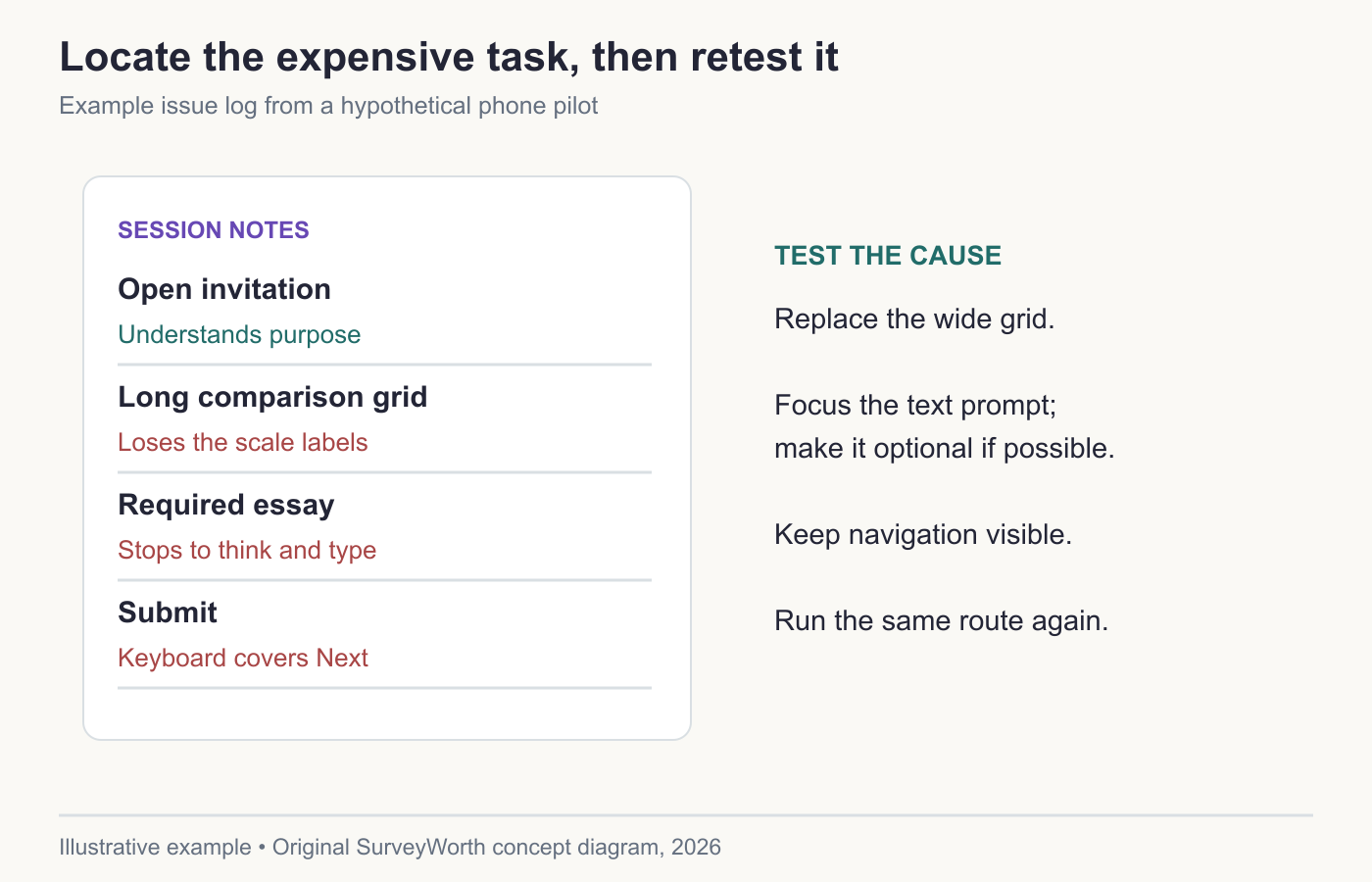
Image source: Original SurveyWorth conceptual diagram, 2026. Illustrative, not observed data or a product screenshot. Based on “Use dropout to locate the expensive minute”.
| Route | What to time | Design decision |
|---|---|---|
| No relevant experience | Screener and exit | End quickly without forced ratings. |
| Typical experience | Core items and one follow-up | Use as the invitation estimate if representative. |
| Complex experience | All branches and optional comment | Check whether a later interview is better. |
If a five-minute median hides a 14-minute service-failure path, the invitation should not simply promise five minutes to everyone. Make optional text clearly optional, remove items with no decision use, and retest after changing logic. Typeform’s survey-design review supports piloting and mobile checks; the actual completion-time claim must come from your own pilot. Use the pilot protocol to record those times.
Use dropout to locate the expensive minute
A seven-minute survey may be acceptable for a motivated specialist, while a two-minute intercept can feel costly during checkout. The useful measure is not a universal minute target but the point at which burden outweighs relevance for this audience. Typeform’s response-rate discussion surveys factors that affect participation, while QuestionPro’s mobile-design guidance identifies touch and typing costs that a desktop timing test misses. Plot starts, each-item views, skips, and quits by route; an abrupt fall at one matrix suggests a layout problem, not necessarily excessive total length. Revise that item and run a new pilot before changing the invitation-time claim.
Frequently asked questions
Should I show a progress bar?
Use one when it is accurate for the respondent’s route. Branching can make a single percentage misleading.
Is every open-text question too long?
No. A focused optional explanation may be more useful than several closed questions whose answers are already predictable.
What if one branch is much longer?
Show the timing range in the invitation when the difference is material, or redesign the long branch and retest it.
Choose tools for your next survey.
Explore survey creation software and research tools for your project.
Explore survey softwareKeep reading.

How to Test a Marketing Campaign With Surveys
Use surveys before, during, and after a campaign to test message clarity and track audience response without overclaiming causality.
Read the guide
How to Measure Brand Awareness With a Survey
Measure unaided recall and aided recognition with balanced survey questions and careful sampling.
Read the guide
How to Design a Product Testing Survey
Write product concept, prototype, and post-launch survey questions that fit what participants have actually experienced.
Read the guide