
How to Run an Employee Pulse Survey
Build a short employee pulse survey with focused questions, appropriate frequency, privacy safeguards, and visible follow-through.

An employee pulse survey is a brief, repeated check on a small set of workplace experiences. It is useful when leaders can act on the results and show what changed. Repeating the same questions without follow-through can reduce trust.
Agree on a theme and response plan first
A pulse survey is credible when employees can see that the organization is prepared to act. Choose a theme that a manager or leadership team owns, such as workload clarity, access to tools, or confidence in raising concerns. Decide before launch who will see results, what level of aggregation will be used, and when an update will be shared. Do not ask about issues that nobody is willing to discuss or address.
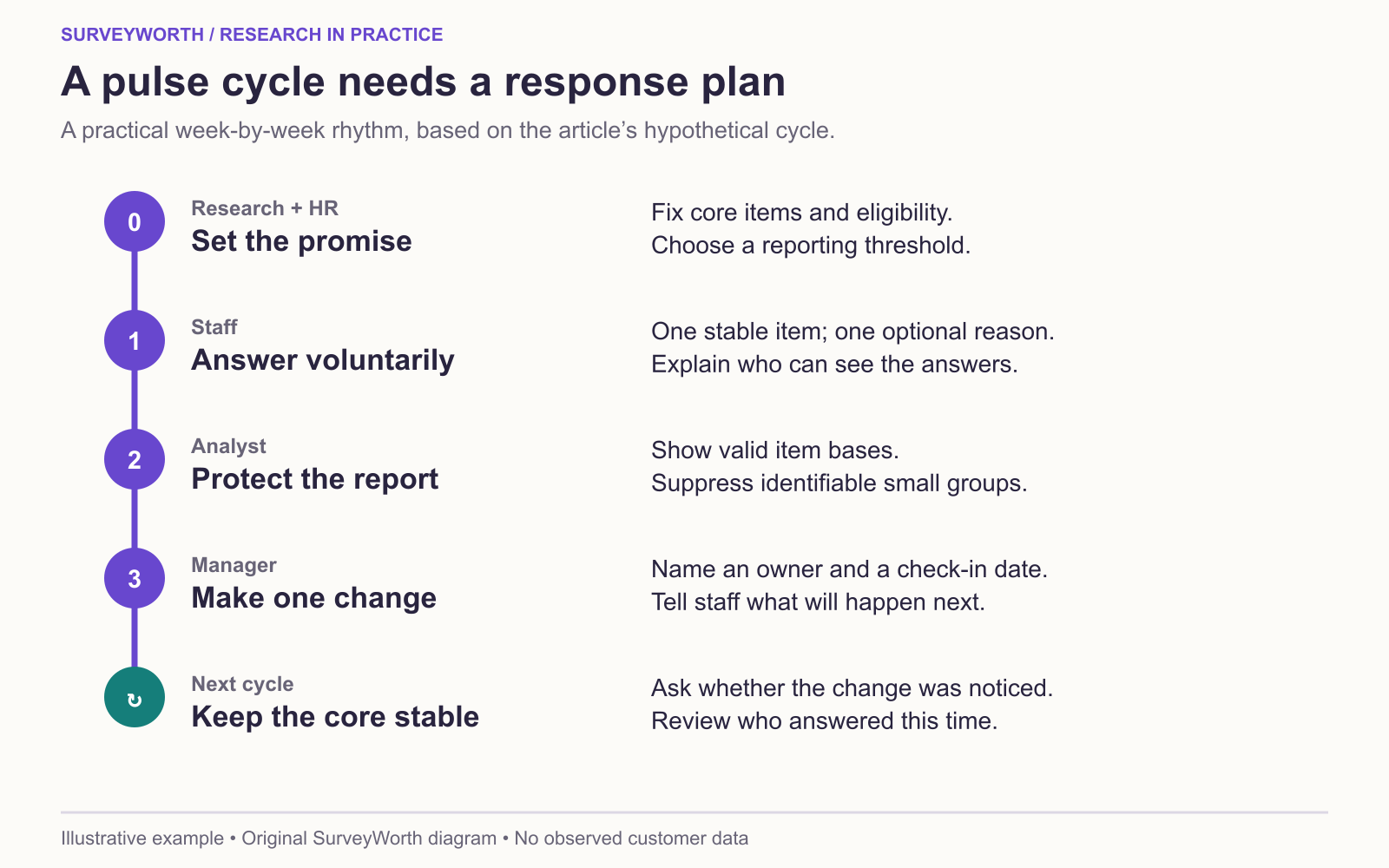
Image source: SurveyWorth original conceptual diagram, 2026. Based on “One pulse cycle, from invitation to response” in this guide. Illustrative example; no observed survey data or official product screenshot.
Keep a stable core item if you want to track change. For workload, “I can complete my highest-priority work within my normal working hours” may be more actionable than “I am happy at work.” Add one optional open prompt such as “What is the main obstacle this week?” The prompt should allow a concrete answer without requiring someone to disclose a personal situation.
Set a schedule that permits action
Weekly surveys may fit a short period of rapid operational change, but they can become noise if leaders cannot review and respond each week. Monthly or quarterly pulses allow more time for change to take effect. Explain whether the survey is a one-off check or a repeated measure. If the same item is repeated, keep its wording and scale stable; a sudden improvement after changing the question is not a clean trend.
Limit the number of questions and avoid sending several teams’ surveys at once. Track participation by broad group only when reporting safeguards permit it. A low response may reflect fatigue, lack of trust, or simple timing; do not assume one explanation without listening.
Make anonymity operational
If you call the pulse anonymous, inspect invitation IDs, login requirements, IP logs, small-team reports, and verbatim comments. In a small group, a rare role and tenure combination can identify an employee. Set a reporting threshold appropriate to the organization and avoid slicing results into groups too small to protect respondents. If individual follow-up is valuable, provide a separate voluntary contact path and explain that it is separate.
If responses are confidential instead, say who can see individual answers and what they can do with them. Avoid broad promises such as “Only HR sees this” unless permissions, exports, and dashboards enforce that rule.
Share what happened next
A useful follow-up says: “We heard that priority changes are frequent. Team leads will publish the top three priorities each Monday. We will check again next month.” It also says when an issue cannot be fixed immediately and why, without dismissing the feedback. Report themes without exposing individual comments. A score alone is not a response plan.
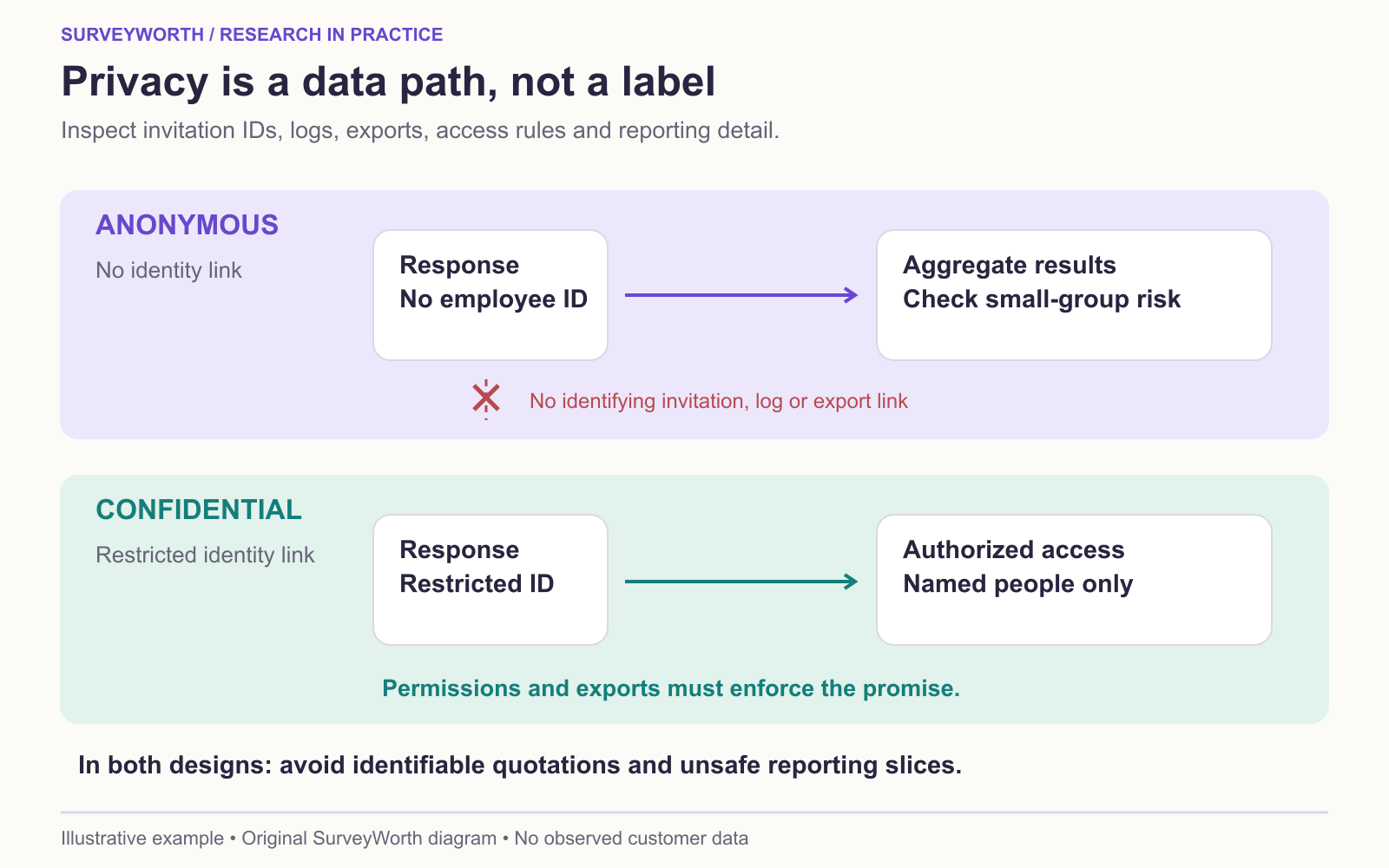
Image source: SurveyWorth original conceptual diagram, 2026. Based on “Make anonymity operational” in this guide. Illustrative example; no observed survey data or official product screenshot.
When the next pulse arrives, compare the same core item with the same population and collection method. Review other evidence such as workload records or team discussions. A change in score is a signal; it does not establish that one management action caused it. Sustained trust comes from accurate privacy promises and visible, proportionate action.
Prepare managers to receive the result
Managers should know the privacy rules, the level of detail they will see, and how to discuss findings without trying to identify respondents. A pulse is not a performance score for a manager. Train leaders to acknowledge uncertainty, ask for ideas in a safe setting, and commit to a small number of visible actions. If employees see a search for “who wrote this,” future participation and honesty will suffer.
One pulse cycle, from invitation to response
QuestionPro’s pulse-survey guide describes a short recurring instrument with stable trend items and rotating topics; Typeform’s engagement-question guide separates constructs that are often blurred in a single “morale” score. For a hypothetical quarterly pulse, keep “I know what is expected of me” and “I have the tools to do my work” fixed, while rotating a question about current workload. Record the exact wording and eligibility each round so a change can be interpreted.
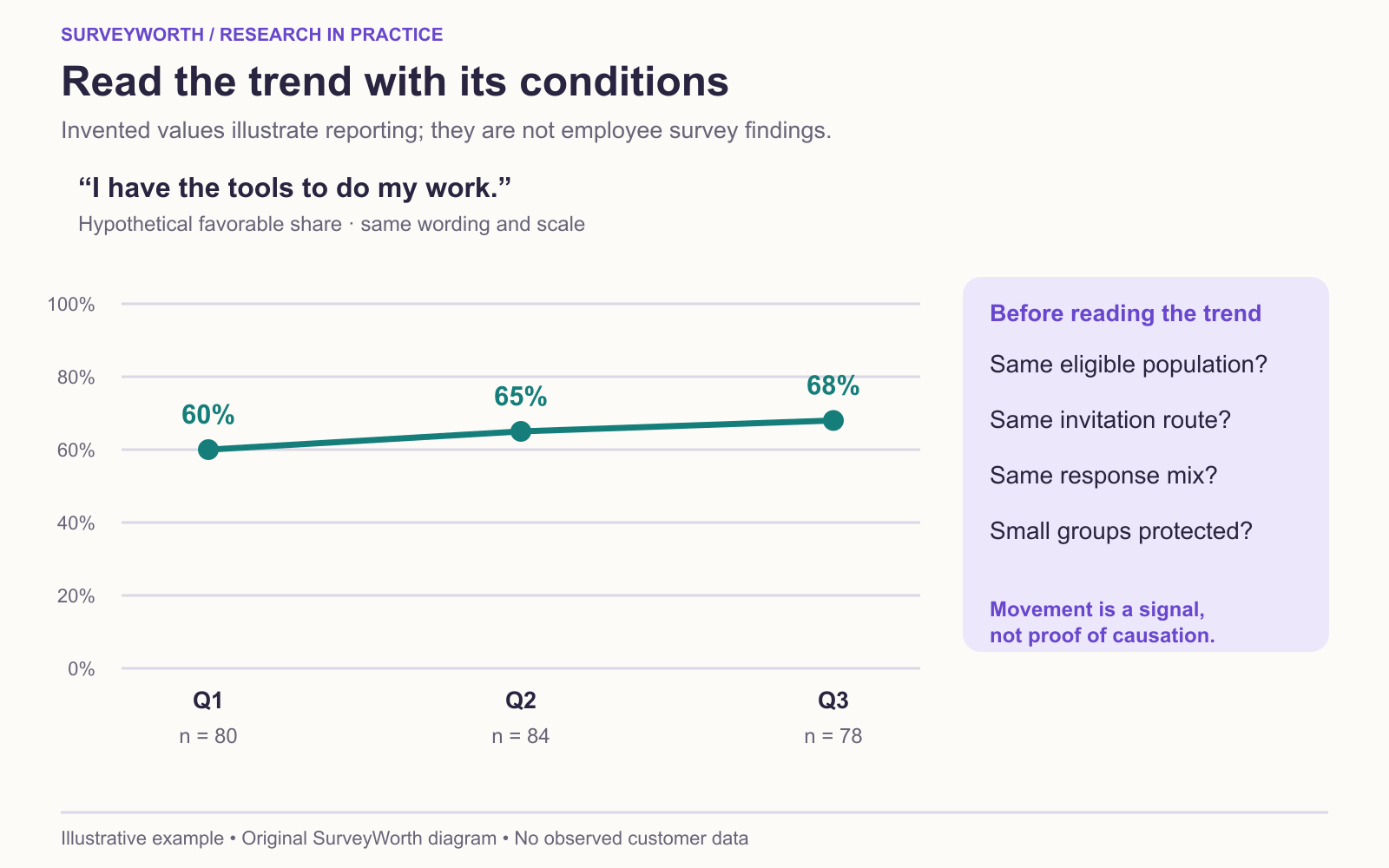
Image source: SurveyWorth original conceptual diagram, 2026. Based on “Share what happened next” in this guide. Illustrative example; no observed survey data or official product screenshot.
| Week | Owner | Output |
|---|---|---|
| 0 | Research and HR | Confirm items, invitation group, and confidentiality threshold. |
| 1 | Staff | Complete the short pulse voluntarily. |
| 2 | Analyst | Share item bases, distribution, and suppressed small groups. |
| 3 | Manager | Name one change, owner, and check-in date. |
| Next cycle | Research | Ask whether the change was noticed; keep core items stable. |
Do not promise anonymity if invitations or exports can identify respondents. The anonymous-form guidance is a useful configuration checklist, while the actual reporting rule belongs to the employer’s system. A team that sees weak tool access should investigate the workflow, not simply tell staff to score it higher. The privacy distinction should be settled before the invitation is written.
Plan the response before asking a sensitive item
If a pulse asks about workload, decide who can act on it before sending. A manager might be able to rebalance a schedule; a company-wide policy issue needs a different owner. Involve.me’s internal-communications article connects employee feedback to follow-up communication, and Typeform’s engagement guide supplies candidate dimensions. A useful update after fieldwork says what the team heard, what it will test, and when staff will hear back. For a small group, report broad patterns and suppress identifiable quotations. If no action can be taken this quarter, explain that limit in the invitation rather than collecting a promise the organization cannot keep.
Frequently asked questions
Should managers see individual responses?
Access should match the privacy promise and the need to act. For sensitive topics, aggregate reporting with safeguards is generally more credible than sharing identifiable comments.
Can a pulse replace a full engagement survey?
No. It is a focused check. Deeper research may be needed to understand underlying causes.
Should every pulse include demographics?
Only collect a segment variable when it supports a planned decision and reporting can protect small groups. An unnecessary field can increase identification risk.
Choose tools for your next survey.
Explore survey creation software and research tools for your project.
Explore survey softwareKeep reading.

How to Test a Marketing Campaign With Surveys
Use surveys before, during, and after a campaign to test message clarity and track audience response without overclaiming causality.
Read the guide
How to Measure Brand Awareness With a Survey
Measure unaided recall and aided recognition with balanced survey questions and careful sampling.
Read the guide
How to Design a Product Testing Survey
Write product concept, prototype, and post-launch survey questions that fit what participants have actually experienced.
Read the guide