
Anonymous vs. Confidential Surveys: What Is the Difference?
Understand the difference between anonymous and confidential surveys and avoid promises your data collection cannot support.

An anonymous survey is designed so responses cannot reasonably be linked to a person. A confidential survey may collect or allow identification, but access and use are restricted. The distinction matters most when you ask about sensitive experiences, such as workplace concerns.
Map identification from invitation to report
Start with the invitation. A generic public link can support anonymity more easily than a personalized link that records who opened and completed the form. Next inspect the form and hosting platform: Does it store IP addresses, account IDs, browser data, or hidden fields? Then inspect integrations, exported spreadsheets, and analytics. A respondent may be anonymous to one team but identifiable to an administrator with access to another system. Your public promise should reflect the whole workflow.
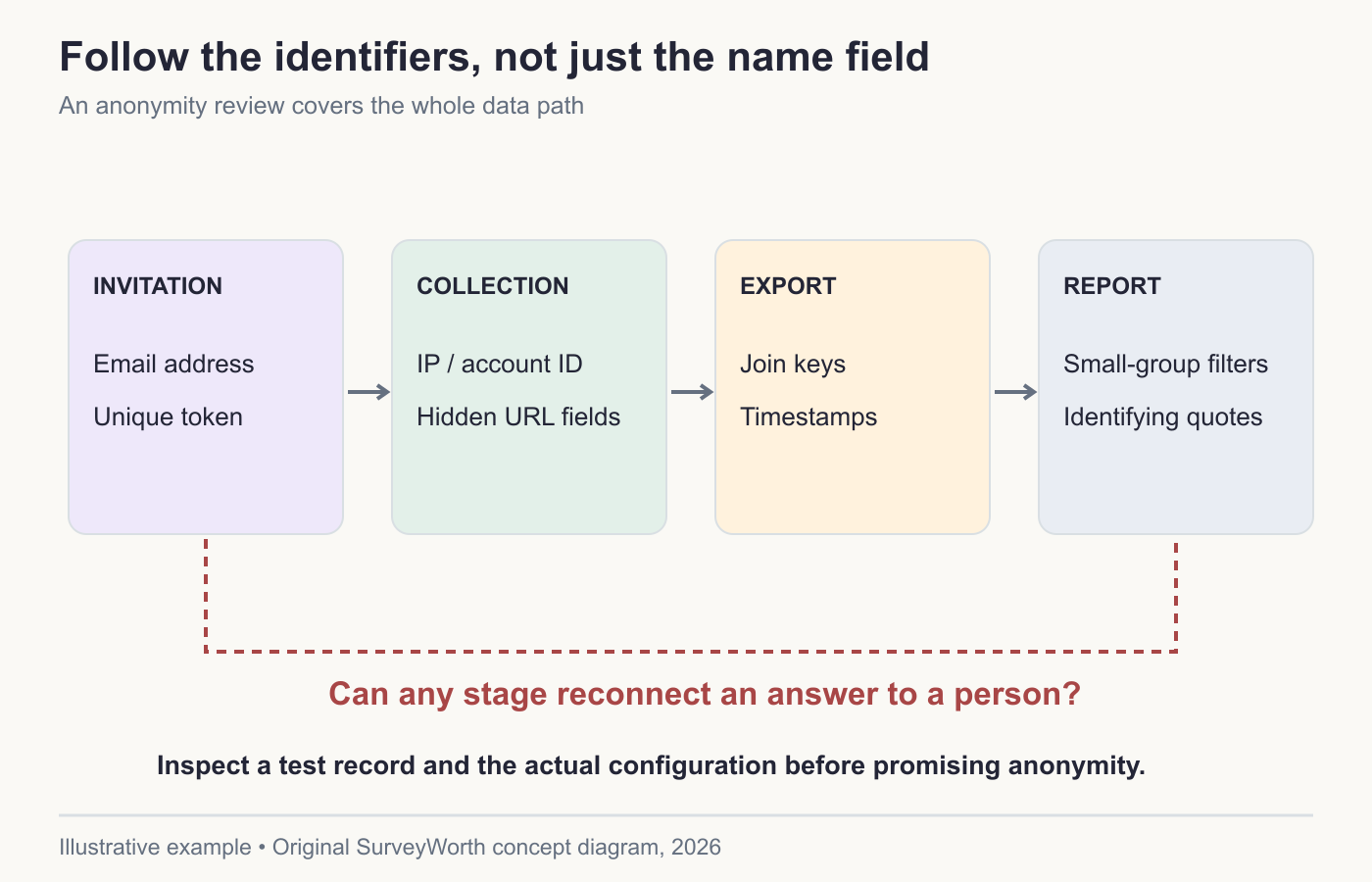
Image source: Original SurveyWorth conceptual diagram, 2026. Illustrative, not observed data or a product screenshot. Based on “Map identification from invitation to report”.
Identification can also happen through answers. In a 12-person department, a combination of job title, tenure, location, and a detailed comment may reveal the writer. Removing names is insufficient. Limit optional demographic items and apply sensible reporting thresholds. For a small group, it may be safer to report themes across a larger unit or omit verbatim comments.
Match the design to the purpose
If the goal is to measure workplace climate, individual follow-up may be unnecessary and anonymity can support candor. If the goal is to resolve a customer support issue, the team may need contact information; confidentiality is the accurate promise. A hybrid design can collect survey answers anonymously while offering a separate optional contact form. The separation must be real: do not pass a response ID into the contact form if that would link the two.
For an incentivized survey, collect prize-entry information in a separate system or step if you promise anonymous answers. Verify the systems cannot be joined through identifiers or timestamps in a way that defeats the promise. Be particularly careful when the incentive is conditional on detailed response content.
Write a statement people can understand
Avoid vague claims such as “Your information is safe.” Say what is collected, who sees individual responses, how results will be reported, and whether follow-up is possible. For example, a confidential survey could say: “The research team can see individual answers. Managers will receive a summary, not a list of names and responses.” Use this only if access controls and reporting practice match it.
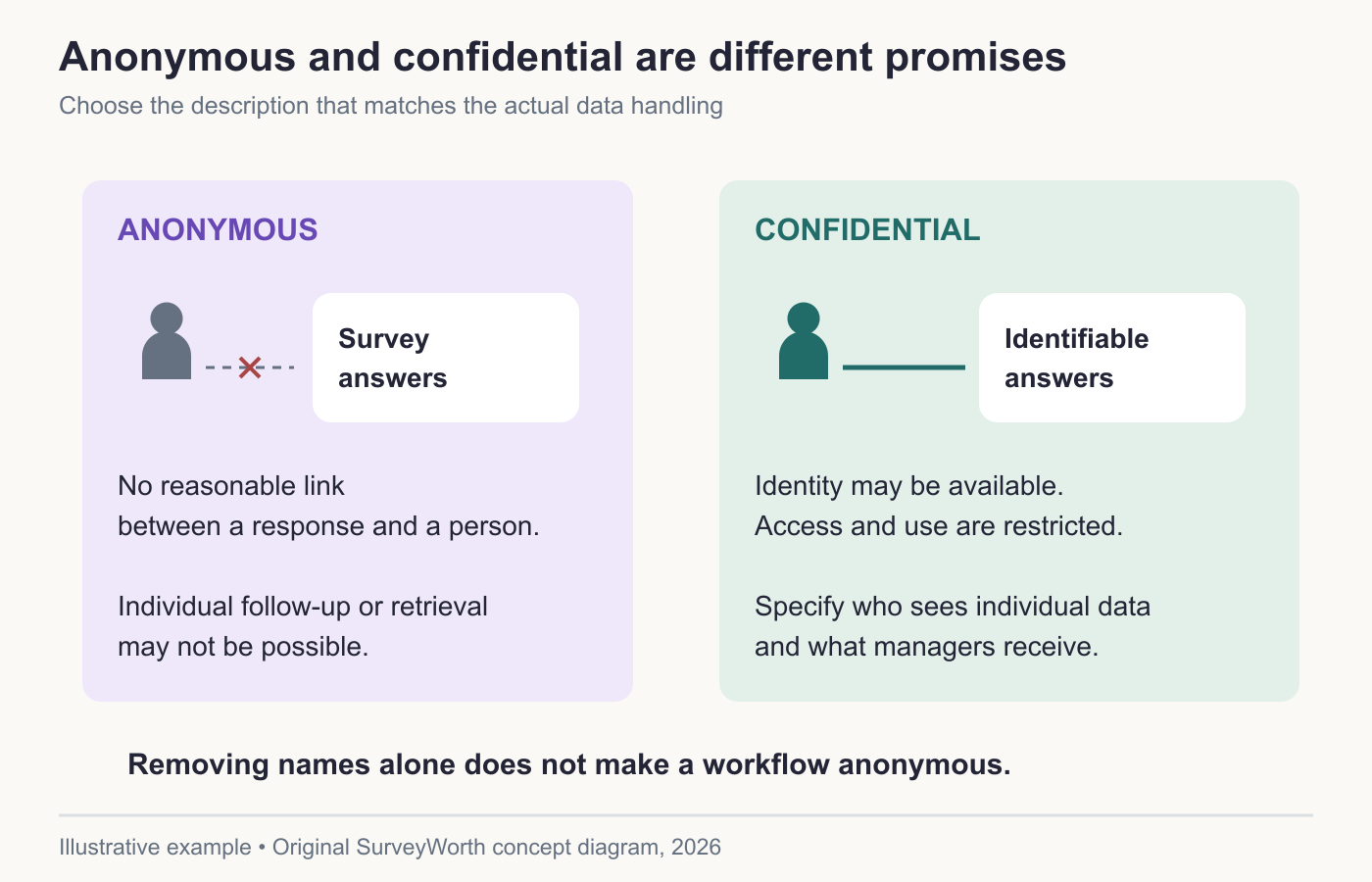
Image source: Original SurveyWorth conceptual diagram, 2026. Illustrative, not observed data or a product screenshot. Based on “Write a statement people can understand”.
If answers truly cannot be linked to individuals, explain the consequence: you may be unable to retrieve or delete one person’s response later or reply to a specific complaint. If confidentiality is used, set access and retention rules and make the opt-in for follow-up clear.
Recheck after every platform change
A survey may be anonymous at launch and become identifiable after a new analytics tag, email integration, or export field is added. Review the setup when the form is copied, embedded on a new site, or connected to a CRM. The label in the invitation should be tied to the actual configuration of that version, not to a general belief about the survey platform.
When a survey is translated or distributed through several channels, verify the privacy statement in every version. A paper form collected in a box, a public web link, and a personalized email link may have different identification risks. Do not use one blanket claim unless all routes meet it. If routes differ, either harmonize the collection method or explain the difference clearly to each participant before they answer.
Follow one response through the data flow
A practical anonymity review begins before the first invitation. Write down every field created at each step, including the invitation token, hidden form fields, server logs, analytics, export columns, and optional prize entry. Involve.me’s anonymous-form walkthrough highlights that removing the name field alone is insufficient; Typeform’s anonymous-survey guide likewise treats settings and distribution as part of the promise. If an employee’s unique team, role, and free-text story identify them, the response may be recognizable even when no name is stored.
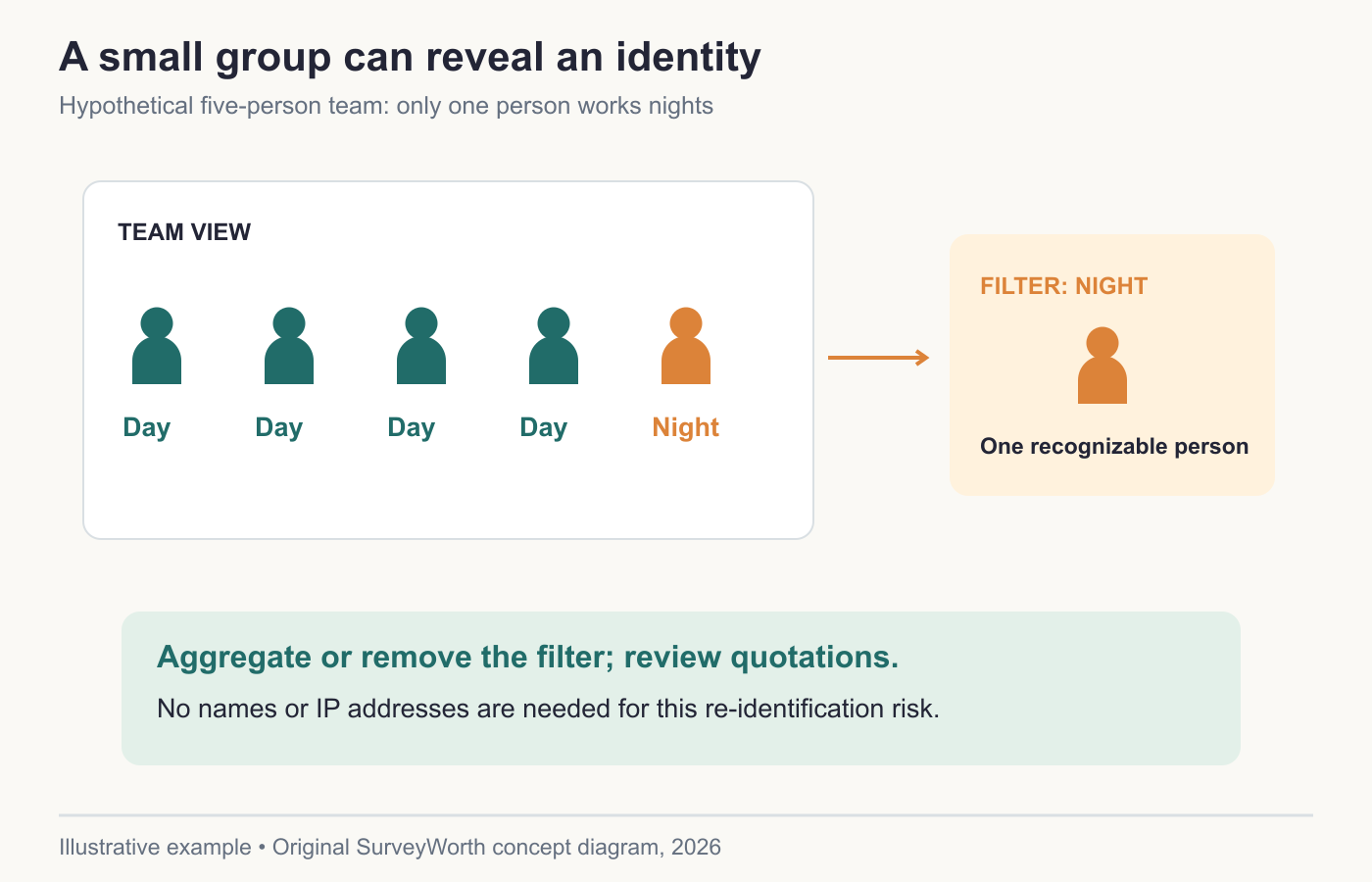
Image source: Original SurveyWorth conceptual diagram, 2026. Illustrative, not observed data or a product screenshot. Based on “Test the promise with a realistic small group”.
| Stage | Question for the owner | Evidence to retain |
|---|---|---|
| Invitation | Is a unique link tied to an email address? | A sample invitation and token settings. |
| Collection | Are IP, account ID, and URL parameters saved? | Platform configuration and a test export. |
| Reporting | Can a small team or quote identify a person? | Minimum-group rule and redaction review. |
Do a dry run with a test account and inspect the exported record, not merely the form’s public screen. If follow-up is necessary, call the workflow confidential and describe who can see individual answers. Typeform’s compliance discussion is a prompt to check actual data handling; it is not a substitute for the organization’s privacy review. The employee-pulse guide shows how this decision affects group reporting.
Test the promise with a realistic small group
Suppose only one person in a five-person team works a night shift. A report filtered by team and shift may identify that respondent even if names and IP addresses were never saved. Remove or aggregate the filter and review quotations before release. Jotform’s employee-anonymity guidance and Jotform’s walkthrough of SurveyMonkey anonymity settings describe form settings, but neither can verify the configuration of another organization’s analytics, HR export, or reporting dashboard. Record the exact tested configuration and invitation text together. If a later integration changes the data flow, repeat the test and update the promise. A careful privacy claim is evidence about a specific workflow, not a permanent product label.
Frequently asked questions
Can I offer a prize and keep responses anonymous?
Yes, if entry details are collected separately and cannot be linked back to answers. Test the separation before claiming anonymity.
Can anonymous responses be deleted on request?
That may be impossible if you cannot identify which response belongs to the requester. Explain this limit in advance.
Can a personalized invitation still be anonymous?
It may be possible only if the invitation system cannot link the token, timing, or response back to the person. Verify that separation in the actual export and logs before promising anonymity.
Choose tools for your next survey.
Explore survey creation software and research tools for your project.
Explore survey softwareKeep reading.

How to Test a Marketing Campaign With Surveys
Use surveys before, during, and after a campaign to test message clarity and track audience response without overclaiming causality.
Read the guide
How to Measure Brand Awareness With a Survey
Measure unaided recall and aided recognition with balanced survey questions and careful sampling.
Read the guide
How to Design a Product Testing Survey
Write product concept, prototype, and post-launch survey questions that fit what participants have actually experienced.
Read the guide