
How to Use a Churn Survey When Customers Cancel
Create a respectful cancellation survey that identifies reported reasons, supports follow-up, and guides retention improvements.

A churn survey asks departing customers why they are canceling or not renewing. Its purpose is to learn from the experience and improve it. A survey should not block cancellation or pressure someone into giving a reason.
Define the churn event and audience
Cancellation can mean ending a paid subscription, letting a trial expire, downgrading, or simply stopping use. These are different behaviors. Choose the event that matches the decision you want to make and recruit people close enough to it to remember their reasons. Someone who canceled yesterday may answer differently from someone who stopped using a product six months ago.
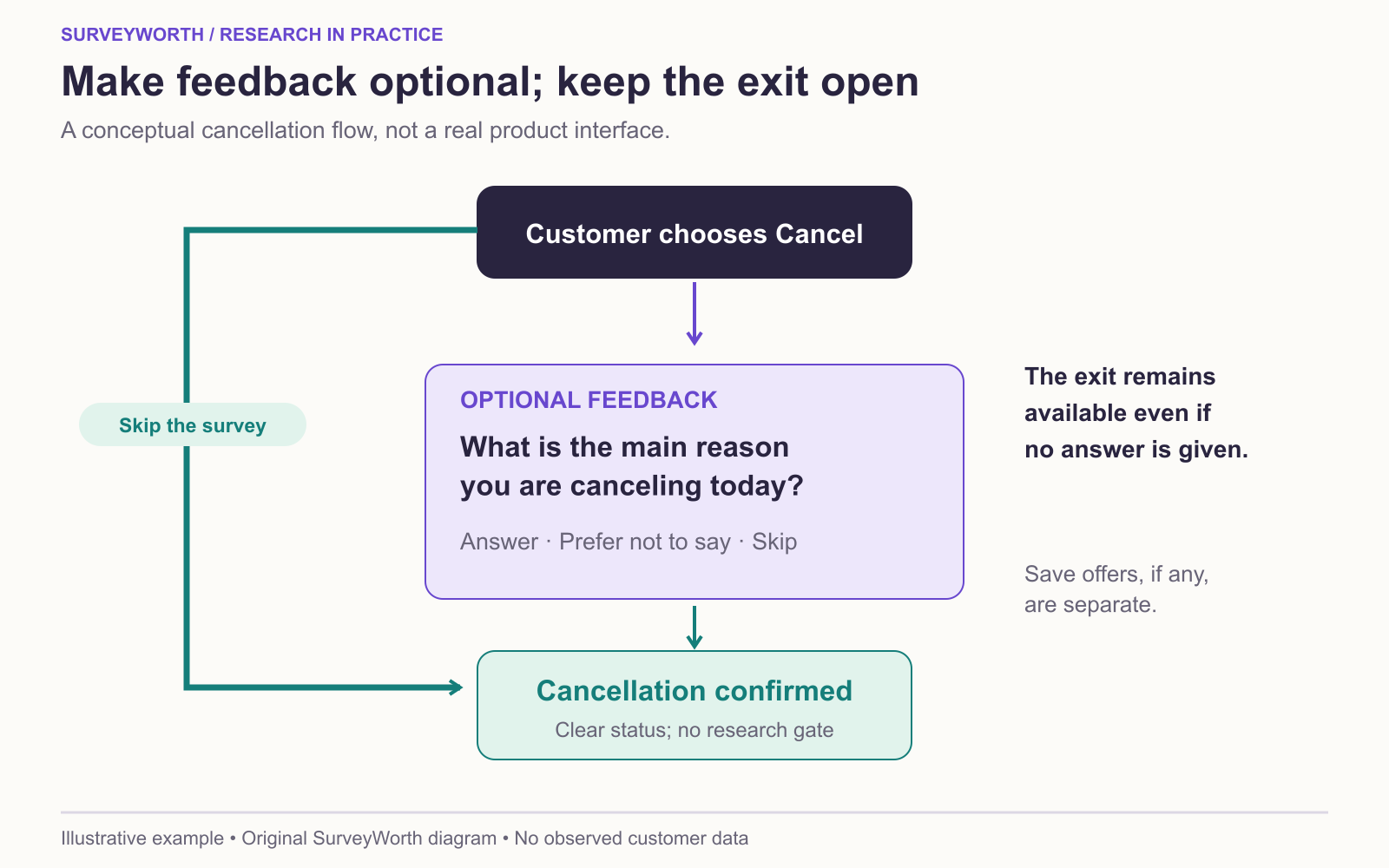
Image source: SurveyWorth original conceptual diagram, 2026. Based on “An optional cancellation flow that preserves the exit” in this guide. Illustrative example; no observed survey data or official product screenshot.
Record tenure, plan, and relevant usage context when appropriate. New customers who could not get started may need a different fix from long-time customers whose needs changed. Keep the survey optional and short; the customer’s primary task is to cancel. Do not make an answer a condition of completing cancellation.
Ask for reasons without forcing a story
Begin with a broad reason question and provide choices that fit the product, including “I no longer need it,” “I did not use it enough,” “The price did not fit,” “I could not accomplish what I expected,” “I had a technical problem,” and “Something else.” These options are examples to pilot, not a universal taxonomy. Add “Prefer not to say” if appropriate. A follow-up can ask which specific outcome was missing or what would have made the product more useful.
If the cancellation involved several factors, a single “main reason” item may oversimplify. Consider “Select all that contributed,” followed by “Which mattered most?” The second question creates a prioritizable measure while the first preserves context. Keep the open response optional and avoid making respondents defend their choice.
Analyze segments without blaming the customer
Compare reason patterns among users who completed onboarding, used core features, or contacted support, with adequate group sizes. A cluster of “too expensive” responses may mean the price is high, the value was not visible, the use case disappeared, or a competitor offered a better fit. Read comments and interview a small set of willing customers before deciding on a price change.
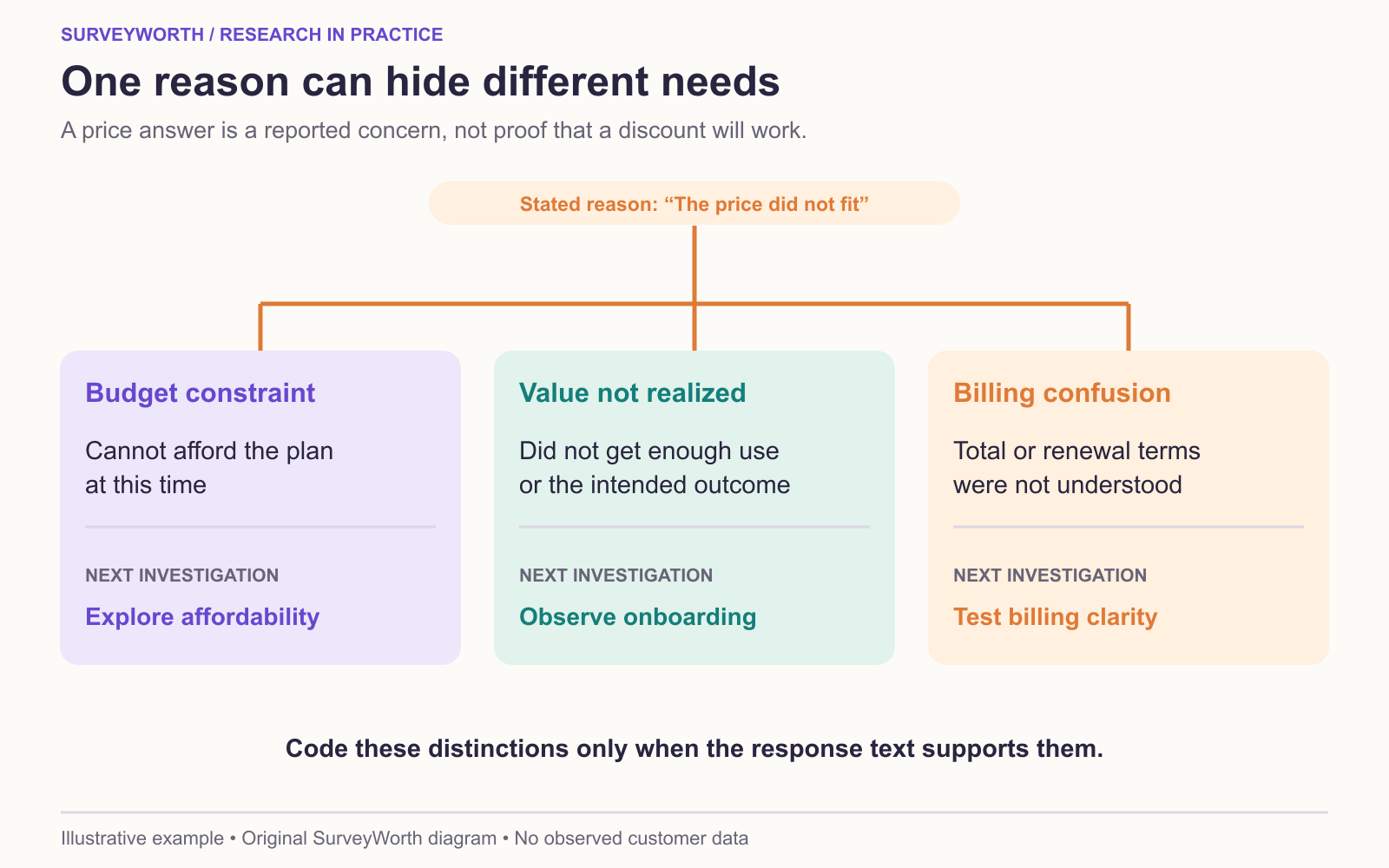
Image source: SurveyWorth original conceptual diagram, 2026. Based on “Build a decision table from stated reasons” in this guide. Illustrative example; no observed survey data or official product screenshot.
An illustrative result might show that recent trial users often say “I could not get started,” while long-time paid users more often say “I no longer need it.” Those groups call for different actions: onboarding observation for the first, product-fit or retention research for the second. Do not combine them into one overall “top churn reason” without segment context.
An optional cancellation flow that preserves the exit
- The customer chooses Cancel and can proceed without answering a survey.
- Before confirmation, ask one optional item: “What is the main reason you are canceling today?” Include “I no longer need it,” “Price,” “It did not meet my needs,” “A technical problem,” “Something else,” and “Prefer not to say.” Test that choices do not overlap badly for the product.
- Offer an optional open answer: “What, if anything, could we have done differently?” Do not require it.
- Confirm cancellation clearly. If a save offer is allowed, present it separately and never make it a condition for canceling.
- Report the base of completed cancellations and the subset who answered. Compare themes with usage and support records only where the privacy notice and access rules permit.
A customer who cites price may really have low usage; a customer who cites features may be using an outdated version. Treat the reason as stated feedback, not a proven cause. If a retention offer changes the experience, track its exposure separately. The research team should be able to analyze reasons without counting people who accepted an offer as though they had canceled.
Separate a real cancellation example from a general rule
Involve.me’s published SaaS cancellation account describes its own move from a more complex flow to two open questions and reports an 11% increase in its response rate. That is the vendor’s account of its own change, with its own audience and measurement; it is not evidence that customers in another business would respond the same way. The transferable design choice is to put the reason question after the person can cancel and to avoid making an exit survey a gate.
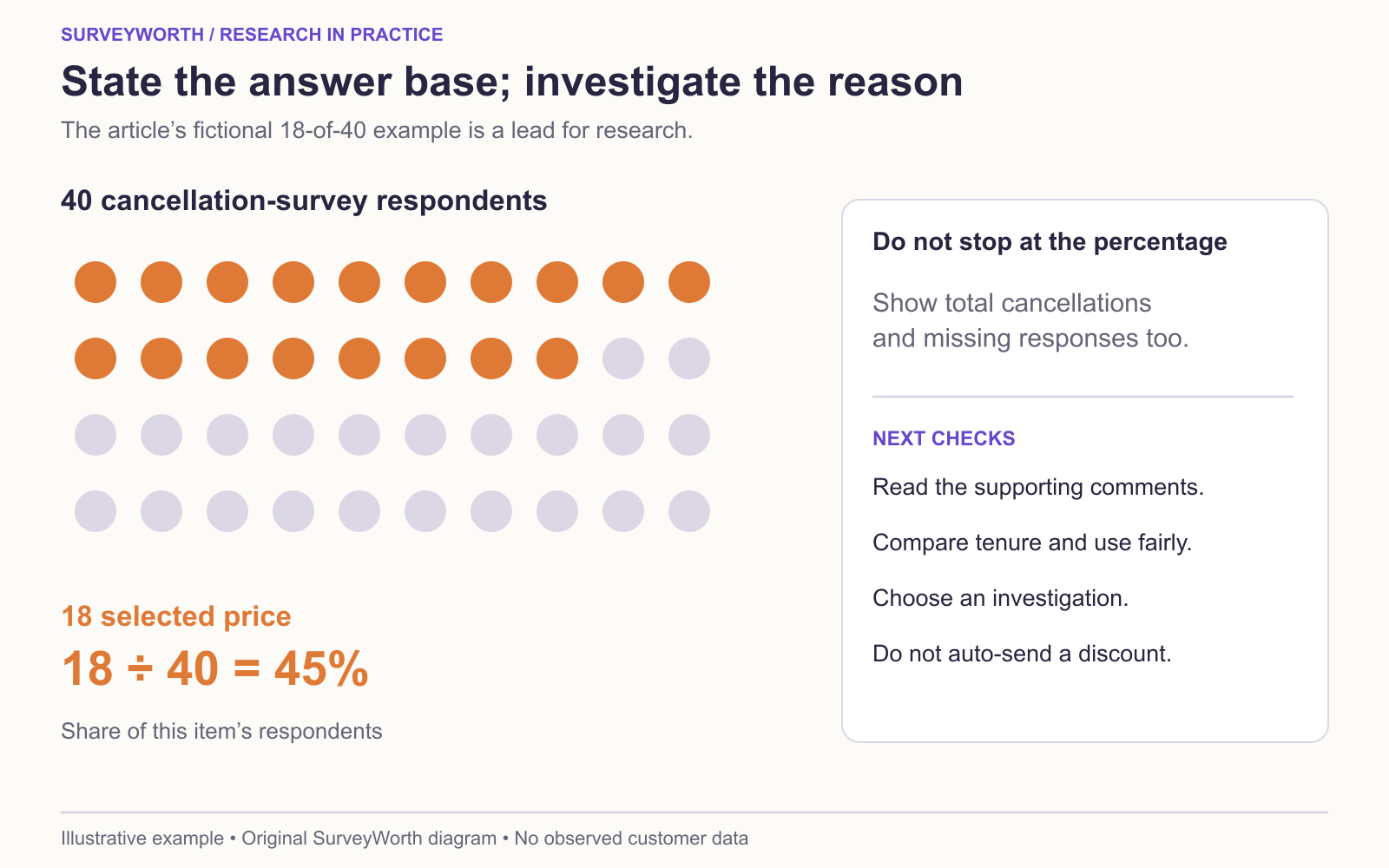
Image source: SurveyWorth original conceptual diagram, 2026. Based on “Build a decision table from stated reasons” in this guide. Illustrative example; no observed survey data or official product screenshot.
A cancellation study can record: cancellation date, plan or tenure at exit, whether the respondent answered, the primary stated reason, and optional detail. Compare reasons with usage and support history only where permission and privacy terms allow. The customer-satisfaction guide can measure a specific earlier service event. QuestionPro’s retention-survey overview identifies several journey points—onboarding, support, renewal, and cancellation—but those audiences answer different questions. A person reporting “price” at cancellation may also have failed to get value during onboarding. Treat the answer as a lead for a cohort review, not proof that a discount would save the account.
For an actionable report, give each reason its respondent base and show the invitation or cancellation base beside it. Assign a separate owner for product fit, technical reliability, and billing clarity. Unmet-needs research can then test whether the problem extends beyond people who chose to cancel.
Build a decision table from stated reasons
If 18 of 40 cancellation-survey respondents select price, report 18/40 and show how many customers canceled but did not respond. Then split “price” comments into “cannot afford,” “not enough value,” and “billing was unclear” only if the text supports those distinctions. Typeform’s account of feedback limits is useful here: a stated reason is not a verified intervention effect. QuestionPro’s relationship-survey guide offers broader trust and experience measures that may help earlier in the lifecycle. Assign each reason a next test: a pricing-clarity usability test, a value-onboarding interview, or a billing audit. Do not automatically send a discount based on one answer.
Choose tools for your next survey.
Explore survey creation software and research tools for your project.
Explore survey softwareKeep reading.

How to Test a Marketing Campaign With Surveys
Use surveys before, during, and after a campaign to test message clarity and track audience response without overclaiming causality.
Read the guide
How to Measure Brand Awareness With a Survey
Measure unaided recall and aided recognition with balanced survey questions and careful sampling.
Read the guide
How to Design a Product Testing Survey
Write product concept, prototype, and post-launch survey questions that fit what participants have actually experienced.
Read the guide