
How to Find Unmet Customer Needs With Market Research Surveys
Discover unmet needs by surveying real tasks, workarounds, priorities, and failed outcomes instead of asking for feature wish lists alone.

An unmet need is a job customers are trying to accomplish that current options do not satisfy well enough. A survey can help you locate patterns, but it works best after exploratory interviews or observation reveal the language people use for the problem.
Start with jobs and workarounds
People often describe a feature they have seen elsewhere because it is easier than explaining the underlying problem. Ask what they were trying to accomplish, what they used, and what made the result unsatisfactory. A workaround is especially informative: spreadsheets, manual reminders, duplicate tools, or asking another person for help show that the job is important enough to spend effort on.
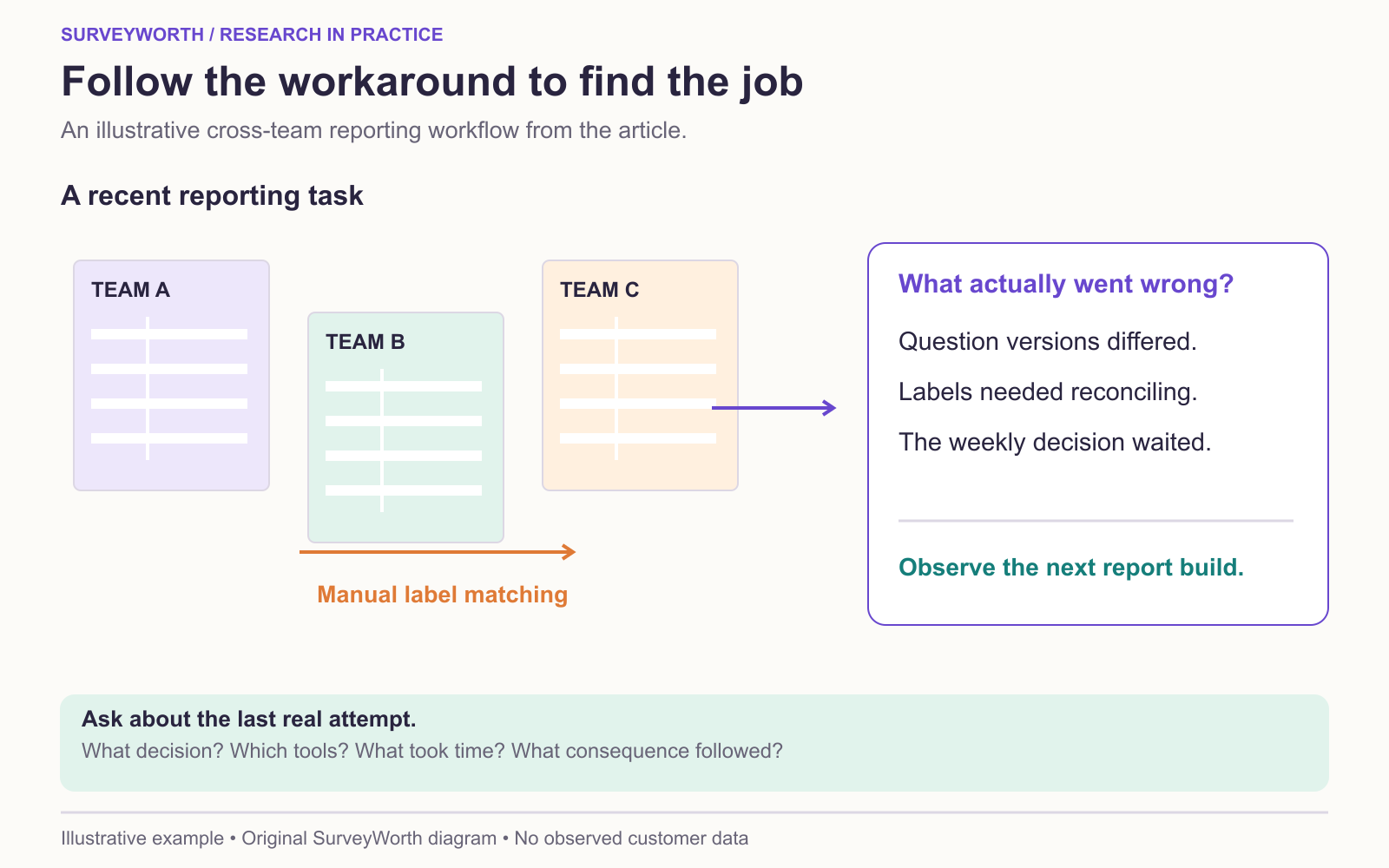
Image source: SurveyWorth original conceptual diagram, 2026. Based on “Separate the job, the workaround, and the feature request” in this guide. Illustrative example; no observed survey data or official product screenshot.
A recent-event prompt reduces vague speculation: “Think of the last time you needed to compare survey responses across teams. What were you trying to decide? What did you use? What took the most time?” The answers reveal context, not just stated preference. Conduct exploratory interviews first if you do not yet know the common tasks or vocabulary. Then use a survey to assess how often those tasks and obstacles appear in a defined audience.
Measure need without leading to your solution
Present outcome statements in neutral language, such as “I can tell which customer problems are increasing,” rather than “I need an AI dashboard.” Ask how important each outcome is and how well current options support it. The gap between importance and current success can highlight candidates for investigation. Do not treat a simple subtraction score as a universal opportunity formula; check task frequency, willingness to change, competing solutions, and implementation cost.
Include “Not relevant to me” so people are not forced to rate a task they never do. Keep the list short and based on earlier research. A long inventory of hypothetical jobs invites fatigue and straight-line answers.
Recruit beyond satisfied current customers
Your current users can identify problems within your product, but they may have adapted to its limitations. Noncustomers and former users can reveal barriers to entry or needs the product never addressed. Recruit each group deliberately and label them separately. A social audience of category enthusiasts may overstate interest in advanced features; a general audience may not understand a niche workflow. The target population depends on the decision.
Prioritize with more than survey frequency
Suppose a survey finds that many respondents dislike manual reporting. Follow-up interviews may show two distinct needs: executives want a quick status view, while analysts need an audit trail. Those are different products and buyer contexts. Compare severity, frequency, current workaround, willingness to switch, and whether the team can deliver a better outcome. Prototype a solution and observe whether it actually improves the job.
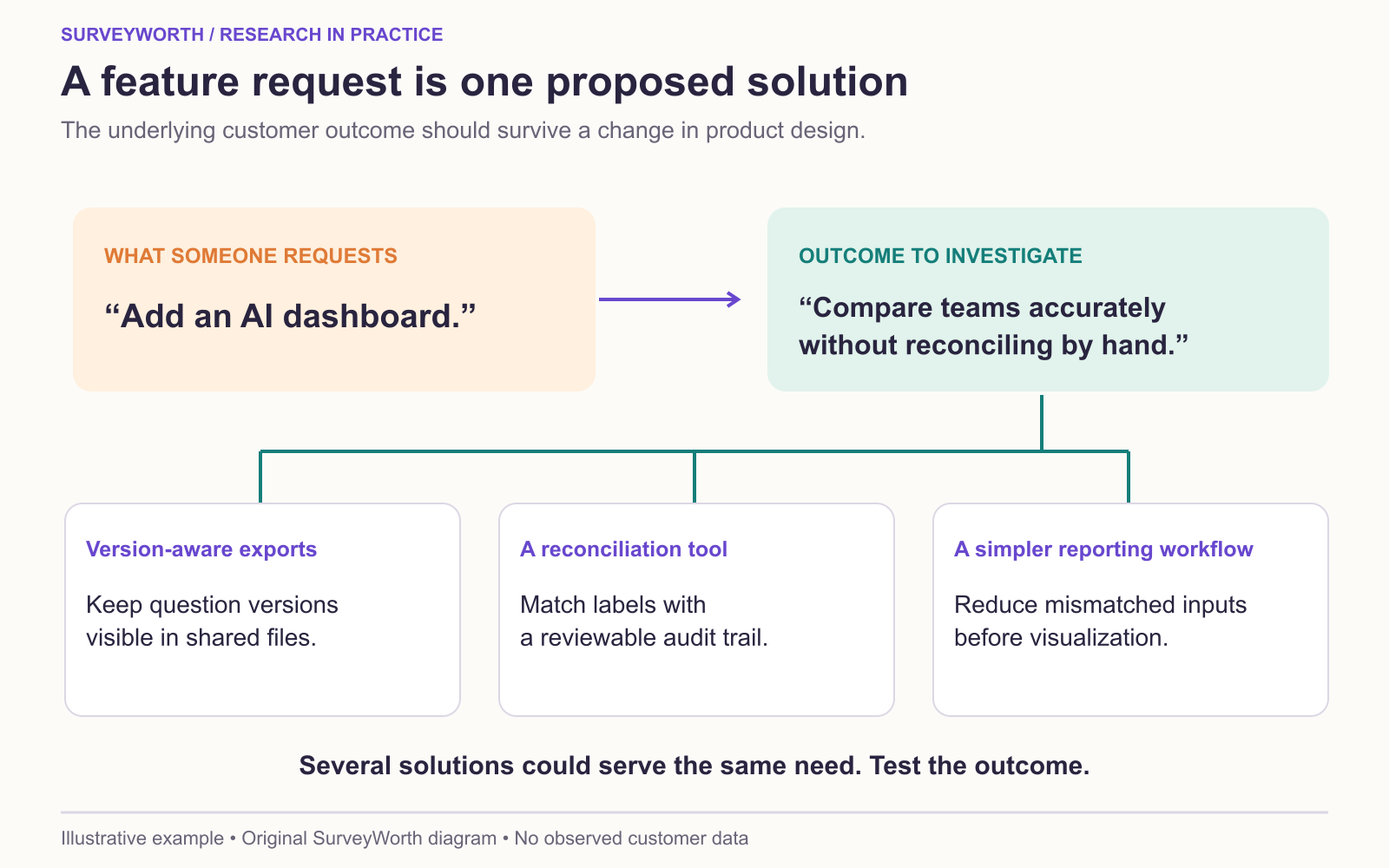
Image source: SurveyWorth original conceptual diagram, 2026. Based on “Measure need without leading to your solution” in this guide. Illustrative example; no observed survey data or official product screenshot.
The survey should end with a shortlist of well-defined problems, not an unfiltered wish list. Record what evidence supports each problem and what uncertainty the next test will resolve. That is the bridge from market research to a product decision.
A prioritization sheet
For each proposed unmet need, document the task, affected segment, how often it occurs in the sampled group, current workaround, consequence of failure, available alternatives, and the next test. Do not treat the largest open-text theme as automatically the best opportunity. A frequent low-impact annoyance may be less valuable than a less frequent task that blocks a critical outcome.
Ask whether the problem exists outside the language of your current product. A customer may request a feature because they know your interface, while a noncustomer may solve the same job in a different way. Comparing those accounts can reveal a broader need. The final recommendation should describe the outcome people seek, not merely the feature they suggested.
Check whether people already spend to solve it
A reported frustration is more compelling when people invest time, money, or effort in a workaround. Ask what they tried and what it cost them, without presuming they would pay for a new product. If nobody has attempted to solve the problem, the issue may be low priority or the survey wording may have prompted abstract agreement. Follow up with behavioral evidence before committing resources.
A need statement should remain useful even if the eventual product changes. Describe the customer outcome in plain language, then test several possible ways to achieve it.
Separate the job, the workaround, and the feature request
QuestionPro’s opportunity-survey guide asks about need frequency, impact, alternatives, and adoption barriers. Typeform’s product-market-fit discussion asks what users would miss without the product. In a cross-team survey-analysis study, a person may request “an AI dashboard,” but the underlying job might be reconciling question versions before a weekly report. Ask about the most recent report, which spreadsheet or tool they used, how long reconciliation took, and what decision was delayed. Those observations can suggest several solutions, not only a dashboard.
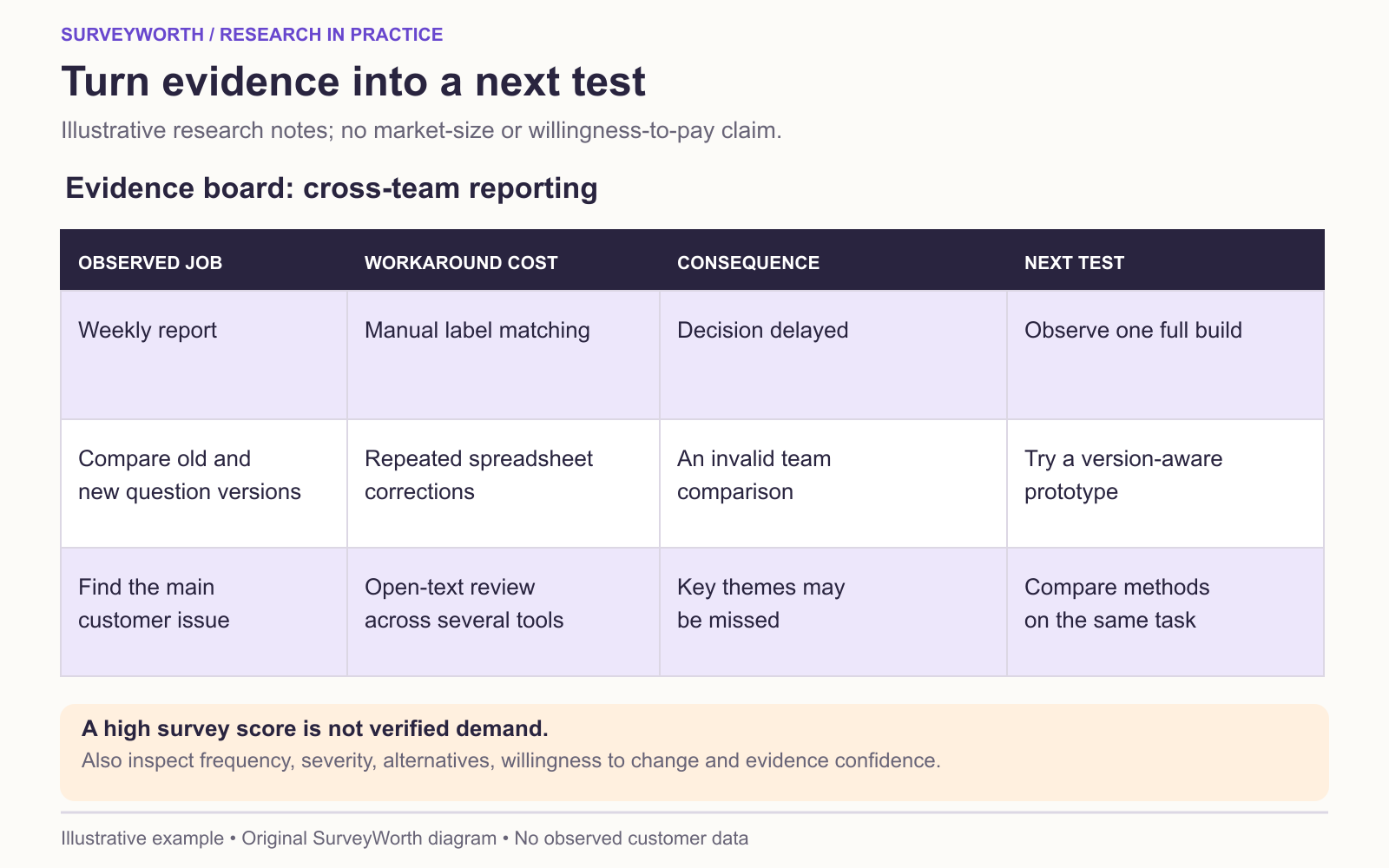
Image source: SurveyWorth original conceptual diagram, 2026. Based on “A prioritization sheet” in this guide. Illustrative example; no observed survey data or official product screenshot.
| Evidence | Interpretation | Next test |
|---|---|---|
| Weekly export and manual label matching | Repeated workflow cost | Observe a complete report build. |
| Incorrect cross-team comparison | Consequence is a wrong decision | Test a version-aware prototype. |
| “AI dashboard” request | Suggested solution, not proven need | Compare alternatives in a task test. |
Typeform’s market-research workflow helps distinguish exploration from measurement. Recruit users, former users, and noncustomers deliberately; report their answers separately. A frequency-by-impact score can help rank follow-ups, but it is a local heuristic, not verified market demand. The product-testing guide covers the next stage after a need is defined.
Rank opportunities without pretending the score is universal
Create a shortlist with frequency, consequence, current workaround cost, and evidence confidence shown in separate columns. A simple product of those columns can be a discussion tool, but its number depends on arbitrary scales and the sample. QuestionPro’s market-opportunity guide discusses several prioritization methods, while Typeform’s product-market-fit article focuses on the segment that would miss a product. Treat both as prompts for a next test. Interview people outside the existing customer list, observe the reporting workflow, and test whether a proposed tool actually reduces errors. Typeform’s product-testing overview separates concept appeal from later prototype and usage evidence. A high survey score alone does not establish willingness to pay or market size.
Choose tools for your next survey.
Explore survey creation software and research tools for your project.
Explore survey softwareKeep reading.

How to Test a Marketing Campaign With Surveys
Use surveys before, during, and after a campaign to test message clarity and track audience response without overclaiming causality.
Read the guide
How to Measure Brand Awareness With a Survey
Measure unaided recall and aided recognition with balanced survey questions and careful sampling.
Read the guide
How to Design a Product Testing Survey
Write product concept, prototype, and post-launch survey questions that fit what participants have actually experienced.
Read the guide