
When Should You Use a Survey Instead of an Interview or Usability Test?
Choose between surveys, interviews, and usability tests based on the decision, the evidence needed, and each method’s limits.

Use a survey when you need comparable answers from many people to a question they can reasonably report. Use an interview when you need to understand how someone thinks or how an experience unfolded. Use a usability test when you need to watch someone attempt a task. The strongest research plans often combine these methods.
A decision tree for choosing a method
- Is the question about what someone actually does in an interface? Observe a usability task. Ask what they expected afterward, but do not replace observation with a memory question.
- Is the question about an unfamiliar motive, constraint, or vocabulary? Start with interviews; use the language you learn to write later survey choices.
- Do you already know the possible answers and need their distribution in a defined group? Use a survey with a sampling plan and a stated denominator.
- Could the decision require more than one kind of evidence? Sequence the methods and assign each a separate claim.
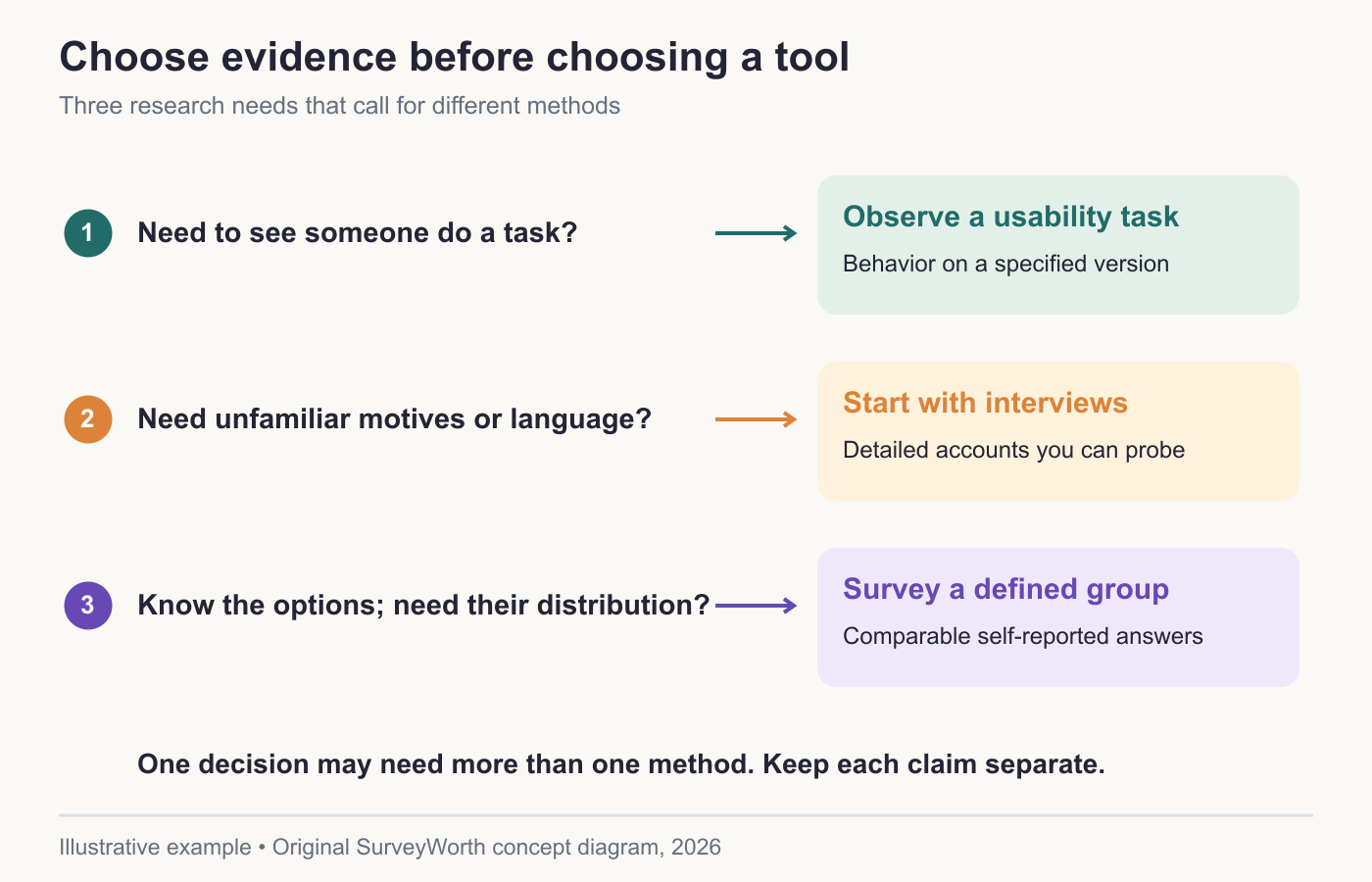
Image source: Original SurveyWorth conceptual diagram, 2026. Illustrative, not observed data or a product screenshot. Based on “A decision tree for choosing a method”.
For a hypothetical meal-kit checkout, a usability test may show that the delivery-date control is missed; interviews may reveal why people dislike the available slots; a survey of recent checkout visitors may estimate how often each stated barrier appears among respondents. The survey cannot prove how many of all potential buyers encounter the problem if recruitment excludes people who left before an invitation appeared. Write the intended claim before choosing the tool.
Translate the business problem into a research question
A team may start with “Our signup conversion fell; run a survey.” That is an instruction to use a tool, not a research question. Break it down: Did people encounter a technical obstacle? Did they misunderstand the offer? Did the audience mix change? Each possibility calls for different evidence. Analytics can locate a step with a drop in completion. A usability test can show whether people can complete that step. Interviews can explore expectations and language. A survey can estimate how many reachable people report a particular obstacle.
The order of methods matters. When the reasons are unknown, use exploratory observation or interviews to discover the vocabulary and events that belong in answer options. A survey designed before that discovery often presents an incomplete list and makes “Other” carry the most interesting answers. Once the candidate explanations are clear, a survey can measure their distribution within a defined audience.
What each method actually produces
A survey produces standardized self-reports. It is efficient when the same question is meaningful for every respondent and when the target population can be reached. It is weak when people cannot remember an event, do not know what influenced them, or need to explain a complex sequence.
An interview produces a detailed account that can be probed. The interviewer can ask “What happened next?” and check what a term means to the participant. It is particularly useful for unfamiliar topics or conflicting motivations. Its depth does not turn a handful of interviewees into a prevalence estimate.
A usability test produces observed behavior on a specified task, product version, and setting. It can reveal that a user overlooks a button even while saying the screen “seems easy.” It does not, without a suitable design, tell you what proportion of all customers will make that mistake. A field observation can add real-world context that a controlled session misses.
Match the claim to the evidence
| Decision question | Best first method | What the result can support | What it cannot establish alone |
|---|---|---|---|
| Where do new users hesitate in checkout? | Observe a realistic usability task. | A reproducible interaction problem on the tested version. | Its prevalence across every customer. |
| Why do shoppers interpret a delivery promise differently? | Interview people after a recent attempt. | Distinct interpretations and language for later questions. | The share of all shoppers holding each view. |
| How common is each reported obstacle among recent eligible visitors? | Survey a defined sample with a clear invitation route. | A distribution for the respondents, or a broader estimate if the design supports it. | Which interface element caused the obstacle. |
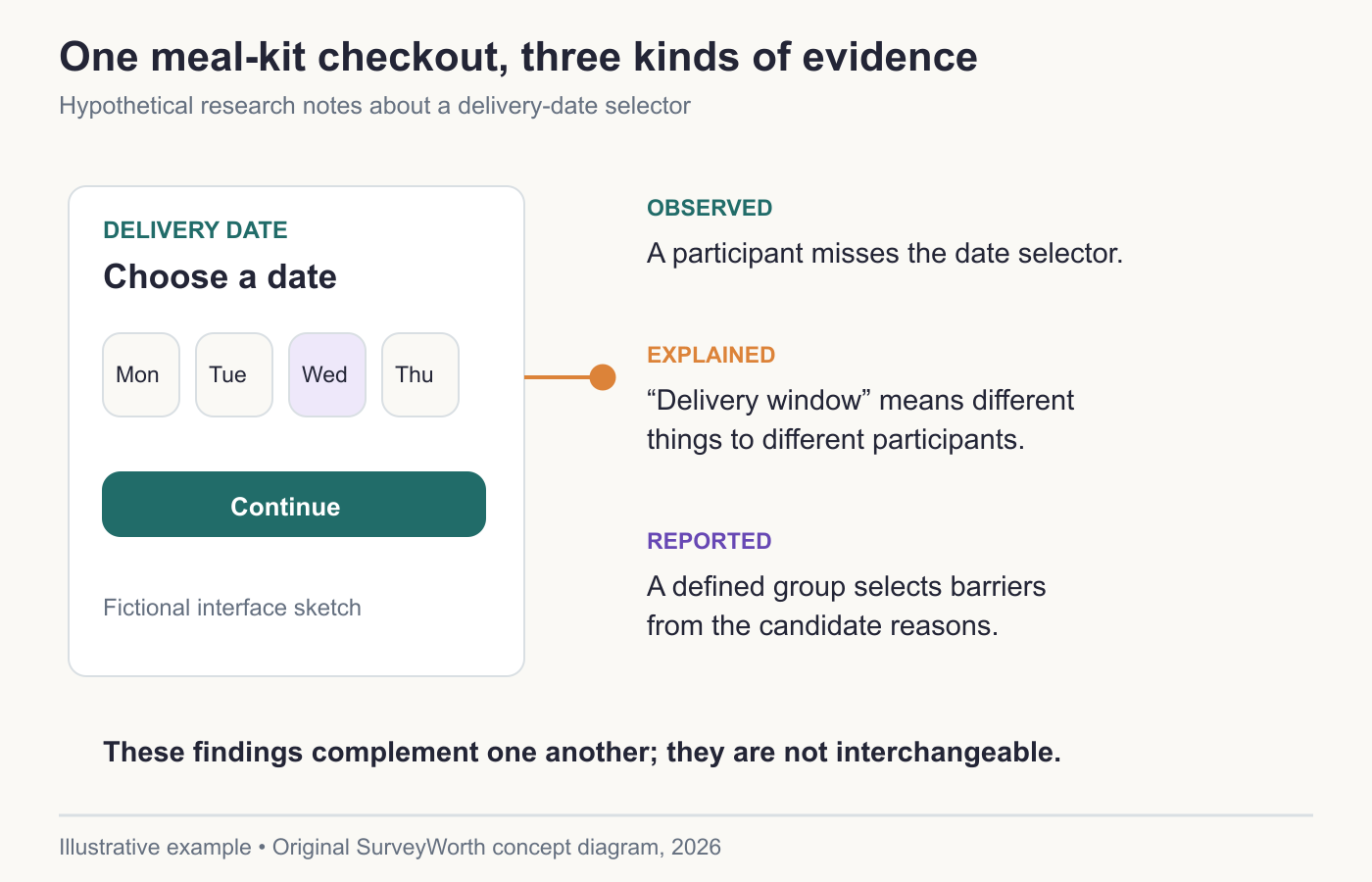
Image source: Original SurveyWorth conceptual diagram, 2026. Illustrative, not observed data or a product screenshot. Based on “Match the claim to the evidence”.
Record the product version, task, recruitment source, field dates, and unanswered questions for every method. If a survey percentage and an observed behavior appear to conflict, first check whether they refer to the same people and event. A respondent can remember a confusing checkout as easy after successfully placing an order; an observed hesitation can still matter even when the person later reports satisfaction. Investigate that difference before collapsing the evidence into a single score.
Sequence methods around one decision
Nielsen Norman Group’s method-selection article explains why a survey cannot replace observation when the question is about behavior. Typeform’s collection-method guide compares ways to gather standardized and exploratory data. For a checkout team, begin with logs to locate the drop-off, observe a task to see whether a delivery-date control is missed, interview people to learn what “delivery window” means to them, then survey a defined group of recent visitors if the distribution of barriers matters. Each method answers a different question.
Write four claims in advance: “A failure occurred at this step,” “Participants interpreted the label this way,” “Among respondents, this share reports the barrier,” and “Changing the label improved completion.” The last claim needs a suitable comparison or test; the first three do not establish it. Typeform’s market-research workflow helps sequence collection and analysis, but the evidence boundary must be named in the report. Stop when the decision owner has enough to choose a test, not when a dashboard contains many numbers. The survey brief can document the owner, population, and action before the team selects a method.
Decide when to stop researching
Do not collect data indefinitely. Agree in advance what finding would trigger a copy change, a prototype test, or a larger study. If several methods point in different directions, inspect the populations and tasks before averaging their results. A survey of existing customers and a usability test with first-time visitors may both be valid while describing different experiences. Write the limits of each method in the final recommendation.
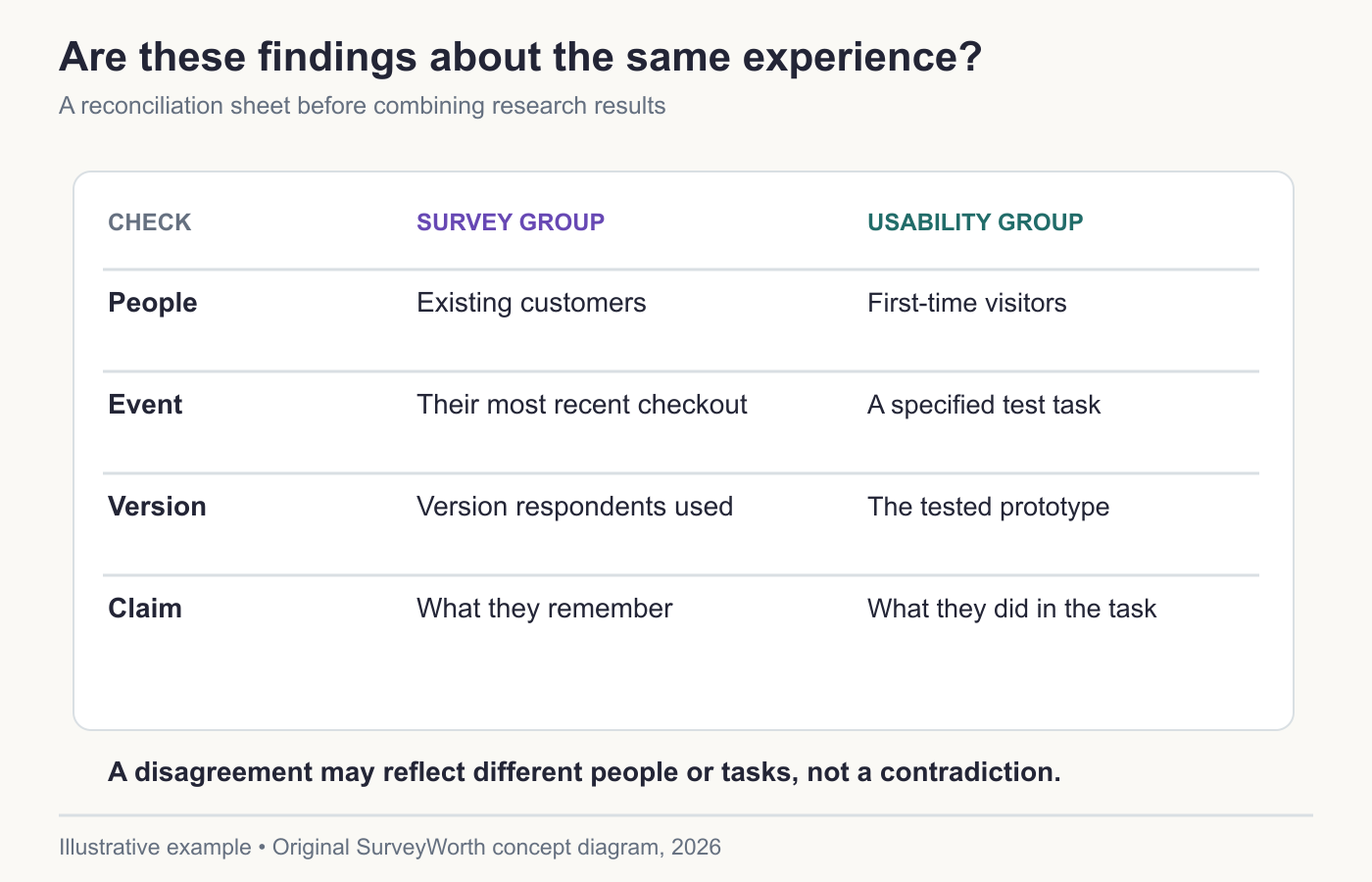
Image source: Original SurveyWorth conceptual diagram, 2026. Illustrative, not observed data or a product screenshot. Based on “Decide when to stop researching”.
Frequently asked questions
Can I include an open-ended question in a survey?
Yes. One focused follow-up can explain a rating. If the topic needs repeated probing, an interview is usually better.
Which method is fastest?
Speed depends on recruitment and analysis. A quickly distributed survey can still produce weak evidence if the wrong people answer.
Choose tools for your next survey.
Explore survey creation software and research tools for your project.
Explore survey softwareKeep reading.

How to Test a Marketing Campaign With Surveys
Use surveys before, during, and after a campaign to test message clarity and track audience response without overclaiming causality.
Read the guide
How to Measure Brand Awareness With a Survey
Measure unaided recall and aided recognition with balanced survey questions and careful sampling.
Read the guide
How to Design a Product Testing Survey
Write product concept, prototype, and post-launch survey questions that fit what participants have actually experienced.
Read the guide